Affiliate Disclosure: This article contains affiliate links. If you purchase through these links, we may earn a small commission at no extra cost to you. This doesn’t influence our recommendations. Read our full Affiliate Disclosure.
Medical Disclaimer: This content is for informational purposes only and is not medical advice. Always consult your doctor before starting any supplement. These statements have not been evaluated by the FDA. Products mentioned are not intended to diagnose, treat, cure, or prevent any disease.
Quick Answer: The best magnesium supplement for sleep after 40 is Doctor’s Best High Absorption Magnesium — it uses the patented TRAACS chelation process for proven absorption, costs about $0.25/day, and is gentle on the stomach. Budget-conscious buyers should choose Nutricost Magnesium Glycinate at $0.15/day, while those wanting practitioner-grade quality should pick Metagenics Magnesium Glycinate. If racing thoughts are your main issue, Momentous Magnesium L-Threonate crosses the blood-brain barrier and targets cognitive overstimulation directly.
Finding the best magnesium supplement for sleep can transform your nights — here’s how to choose the right one.
You’ve tried the blue light glasses. You’ve put away your phone an hour before bed. You’ve even tried melatonin, and now you wake up groggy and worse than before.
Here’s something that might actually work: magnesium. Specifically, the right form of magnesium, taken at the right dose, at the right time. Not all magnesium is created equal — some forms will help you sleep, others will just send you to the bathroom.
I researched the science behind magnesium and sleep, compared the different forms, and tested multiple products to bring you this guide. If you’re over 40 and struggling with sleep, this might be the most important supplement you add to your routine.
Quick Comparison: Best Magnesium for Sleep
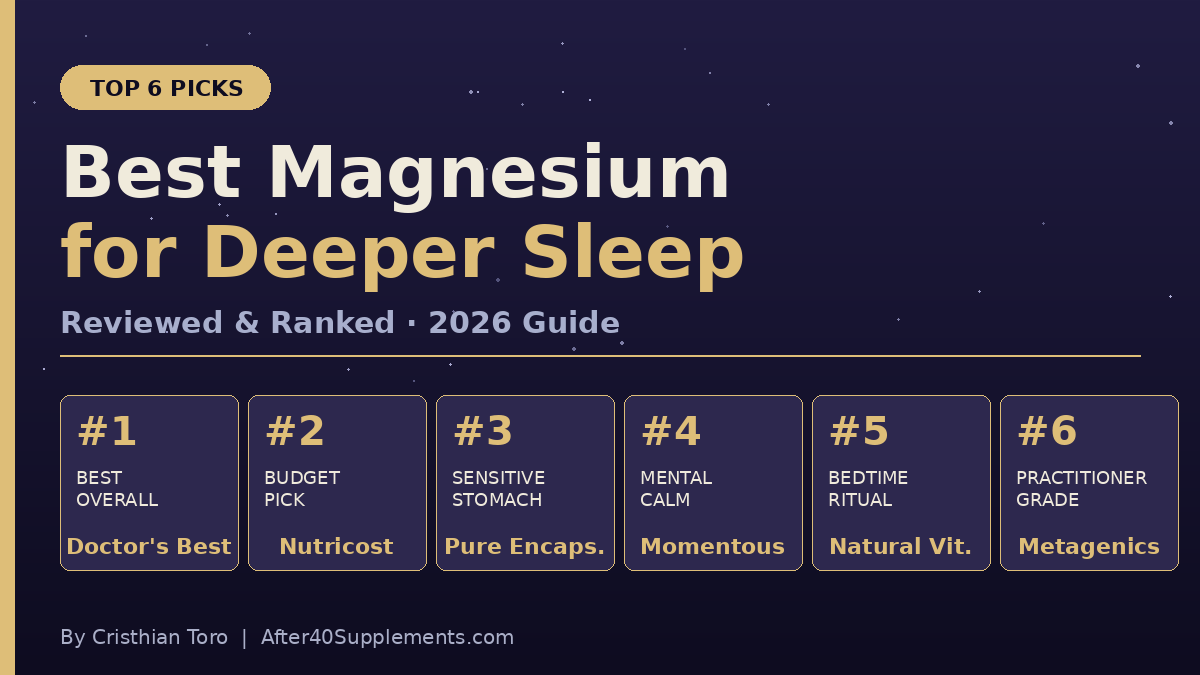
Our 6 top picks at a glance. Short on time? Our #1 is the safe bet for most people.
| # | Product | Best For | Price/day | Buy |
|---|---|---|---|---|
| 1 | ★ Best Overall Doctor’s Best High Absorption Magnesium TRAACS chelated glycinate · gentle on the stomach | Best overall value | ~$0.25 | Check Price → |
| 2 | Nutricost Magnesium Glycinate Pure glycinate · no extras | Budget pick | ~$0.15 | Check Price → |
| 3 | Pure Encapsulations Magnesium Glycinate Hypoallergenic · no additives | Sensitive stomachs | ~$0.50 | Check Price → |
| 4 | Momentous Magnesium L-Threonate Crosses the blood-brain barrier | Racing mind / calm | ~$1.00 | Check Price → |
| 5 | Natural Vitality Calm Powder · bedtime ritual | Relaxing bedtime drink | Varies | Check Price → | 6 | Metagenics Magnesium Glycinate Fully chelated · high absorption | Best Practitioner Grade | ~$0.60 | Check Price → |
Prices may vary. As an Amazon Associate we earn from qualifying purchases, at no extra cost to you.
Why Magnesium Helps With Sleep
Magnesium isn’t a sedative. It doesn’t knock you out like a sleeping pill. Instead, it works by supporting the biological systems that allow your body to relax and fall asleep naturally.
It activates your parasympathetic nervous system. This is your body’s “rest and digest” mode. Magnesium helps calm nerve activity, signaling to your body that it’s time to wind down.
It regulates GABA. GABA (gamma-aminobutyric acid) is a neurotransmitter that quiets brain activity. Low GABA means a racing mind at bedtime. Magnesium binds to GABA receptors and helps them function properly.
It supports melatonin production. Magnesium plays a role in regulating your circadian rhythm by supporting the production of melatonin, your body’s natural sleep hormone.
It relaxes muscles. Those nighttime leg cramps and restless legs that wake you up at 3 AM? Often a sign of magnesium deficiency. Supplementing can reduce these disruptions significantly.
The problem is that roughly half of adults don’t get enough magnesium from diet alone, and absorption decreases with age. A 2012 double-blind, placebo-controlled clinical trial by Abbasi et al., published in the Journal of Research in Medical Sciences, found that 500mg of magnesium daily for 8 weeks significantly improved insomnia severity, sleep time, sleep efficiency, and melatonin levels in elderly subjects compared to placebo. After 40, the odds of being deficient go up considerably.
Which Form of Magnesium Is Best for Sleep?
This is where most people get confused. There are at least 10 forms of magnesium supplements, and they’re not interchangeable. Here’s what you need to know:
Magnesium Glycinate — Best Overall for Sleep
Magnesium bonded to the amino acid glycine. Glycine itself has calming properties — a 2012 study by Bannai & Kawai in the Journal of Pharmacological Sciences demonstrated that glycine ingestion before bedtime significantly improved subjective sleep quality and reduced next-day fatigue. The combination gives you both the relaxation benefits of magnesium and the calming effect of glycine. Highly absorbed, gentle on the stomach, and won’t cause a laxative effect.
Best for: General sleep improvement, falling asleep faster, reducing anxiety before bed.
Magnesium L-Threonate — Best for Brain-Related Sleep Issues
This form crosses the blood-brain barrier more effectively than others, raising magnesium levels in the brain directly. A 2022 randomized controlled trial by Hausenblas et al. found that magnesium L-threonate (Magtein) supplementation significantly improved sleep quality and daytime functioning in adults with self-reported sleep problems.
Best for: People whose sleep issues are related to stress, racing thoughts, or cognitive overstimulation.
Magnesium Citrate — Avoid for Sleep
While citrate is well-absorbed, it has a strong laxative effect. Unless constipation is the reason you can’t sleep, this isn’t the one you want at bedtime.
Magnesium Oxide — Avoid for Sleep
Poorly absorbed — a 2001 study by Firoz & Graber in Magnesium Research found only about 4% bioavailability for magnesium oxide. It’s the cheapest form and commonly found in drugstore supplements, but it’s essentially useless for sleep and often causes digestive issues.
Bottom line: For sleep, stick with glycinate or threonate. Everything else is either less effective or comes with unwanted side effects.
The 6 Best Magnesium Supplements for Sleep
1. Doctor’s Best High Absorption Magnesium — Best Overall
Doctor’s Best uses the patented TRAACS chelation process from Albion Minerals, creating one of the most bioavailable magnesium glycinate supplements on the market. Each two-tablet serving delivers 200mg of elemental magnesium in a highly stable, well-absorbed form.
The chelated glycinate form means minimal digestive issues — a common complaint with cheaper magnesium supplements. At around $15 for a two-month supply, the value is exceptional.
What I like:
- Patented Albion Minerals chelation — proven absorption
- 200mg elemental magnesium per serving
- Very gentle on the stomach
- Excellent value (~$0.25/day)
- Gluten-free, soy-free, non-GMO
What could be better:
- Requires 2 tablets per serving
- Tablet form only (no powder or capsule)
- No additional sleep-supporting ingredients
Dosage for sleep: Take 200-400mg about 1 hour before bed.
Best for: Anyone who wants effective, affordable magnesium for sleep without any extras.
Want a deeper look at our top pick? Read our full Doctor’s Best Magnesium Glycinate Review for a detailed breakdown of ingredients, dosing tips, pros and cons, and how it compares to other brands. Magnesium is also the #1 pick in my Best Supplements for Men Over 40 guide — where I break down why it’s the single highest-impact supplement after 40.
2. Nutricost Magnesium Glycinate — Best Budget Option
Nutricost delivers a straightforward magnesium glycinate supplement at one of the lowest price points in the market. Each capsule provides 140mg of elemental magnesium from magnesium glycinate. It’s manufactured in a GMP-compliant facility and third-party tested.
No frills, no fancy ingredients — just quality magnesium glycinate at a price that makes daily supplementation sustainable.
What I like:
- Extremely affordable (~$0.15-0.20/day)
- Third-party tested
- Simple, clean formula
- 360 capsules per bottle
- Easy-to-swallow capsules
What could be better:
- May need 2-3 capsules for optimal sleep dose
- No NSF certification
- Basic packaging
Dosage for sleep: Take 2-3 capsules (280-420mg) about 1 hour before bed.
Best for: Budget-conscious buyers who want pure magnesium glycinate without paying for brand names.
Also available: Nutricost offers this same formula in a 180-capsule bottle if you prefer a shorter supply, whether you’re testing the product first or don’t want to commit to a 6-month bottle.
Also Worth Considering: VitaUp Magnesium Glycinate
If you’re looking for another affordable magnesium glycinate option, VitaUp is a newer brand worth checking out. Their Magnesium Glycinate provides 200mg of elemental magnesium per serving from magnesium bisglycinate, manufactured in a GMP-compliant, FDA-registered facility in the US.
At around $0.20-0.25/day for a 120-capsule bottle, it’s competitively priced with Nutricost. It’s also third-party tested and free from major allergens. While VitaUp doesn’t have the long track record of established brands, early reviews are positive and the formula is clean and straightforward.
Check VitaUp Magnesium Glycinate on Amazon
3. Pure Encapsulations Magnesium Glycinate — Best for Sensitive Stomachs
Pure Encapsulations is the gold standard for hypoallergenic supplements. Their magnesium glycinate provides 120mg per capsule with absolutely nothing else — no fillers, no allergens, no additives. Every product is designed for people with sensitivities.
It’s third-party tested, manufactured in NSF-registered facilities, and certified gluten-free. If you’ve had digestive issues with other magnesium supplements, this is the safest bet.
What I like:
- Hypoallergenic — free from all common allergens
- Trusted by healthcare professionals
- Zero unnecessary additives
- Very gentle on digestion
- NSF-registered manufacturing facility
What could be better:
- 120mg per capsule (need 2-3 for sleep dosing)
- Premium price (~$0.50-0.70/day)
- Only available in capsule form
Dosage for sleep: Take 2-3 capsules (240-360mg) about 1 hour before bed.
Best for: People with food sensitivities, autoimmune conditions, or anyone who’s had bad reactions to other supplements.
4. Momentous Magnesium L-Threonate — Best for Mental Calm
If your sleep issues are driven by a mind that won’t shut off, magnesium L-threonate deserves serious consideration. This form uniquely crosses the blood-brain barrier, directly raising magnesium levels in the brain where it can calm neural activity and support deep sleep.
Momentous is a well-respected brand in the performance supplement space, with a strong focus on clinically studied ingredients at effective doses.
What I like:
- Crosses blood-brain barrier effectively
- Clinically studied form (Magtein)
- Supports both sleep and daytime cognitive function
- NSF Certified for Sport
- Vegan capsules
What could be better:
- More expensive than glycinate options (~$1.00-1.30/day)
- 3 capsules per serving
- L-threonate has less overall research than glycinate
Dosage for sleep: Take 3 capsules (145mg magnesium) about 1 hour before bed.
Best for: People whose sleep problems are primarily caused by stress, anxiety, or racing thoughts at bedtime.
5. Natural Vitality Calm — Best Powder (Magnesium Citrate)
I generally don’t recommend citrate for sleep due to its laxative effect, but Natural Vitality Calm is the exception for people who want a relaxing bedtime drink ritual. The raspberry-lemon flavor actually tastes pleasant, and the act of slowly sipping a warm magnesium drink can become a powerful sleep signal for your body.
The magnesium is in citrate form, so start with a small dose to assess your tolerance. Many people tolerate it fine at lower doses.
What I like:
- Enjoyable bedtime ritual
- Good flavors (raspberry-lemon is a favorite)
- Dissolves easily in warm water
- Widely available in stores
- No artificial colors or flavors
What could be better:
- Citrate form can cause loose stools
- Contains organic stevia (some people dislike)
- Less ideal form for pure sleep benefits than glycinate
- Need to mix and prepare
Dosage for sleep: Start with 1 teaspoon (about 80mg) in warm water and increase gradually. Most people settle at 1-2 tablespoons.
Best for: People who enjoy a warm drink before bed and tolerate citrate well.
6. Metagenics Magnesium Glycinate — Best Practitioner-Grade
Metagenics is one of the most respected practitioner-grade supplement brands in functional medicine — the kind your integrative doctor likely recommends from their dispensary. Their Magnesium Glycinate uses a fully chelated bisglycinate form designed for high absorption and gentle digestion, manufactured to pharmaceutical-grade quality standards.
What sets Metagenics apart isn’t a single ingredient breakthrough — it’s the consistency of their manufacturing process. Every batch is tested for purity and potency, the formulations are designed by clinical research teams, and the brand has been the standard in functional medicine clinics for over 40 years. If you’ve ever wondered what supplements your doctor would actually take, this is one of them.
What I like:
- Practitioner-grade quality standards
- Fully chelated bisglycinate for high absorption
- Trusted by functional medicine professionals for decades
- Clinically validated dosing
- Gentle on the stomach
- Non-GMO, gluten-free
What could be better:
- Premium pricing (~$0.50-0.70/day)
- Generally requires healthcare practitioner code for direct dispensary purchase (Amazon availability solves this)
- Less consumer brand recognition than retail brands
- No flavor or powder options
Dosage for sleep: Take 200-300mg (typically 2 capsules) about 1 hour before bed.
Best for: Adults over 40 who want the same quality supplement their functional medicine doctor would recommend, those already using other Metagenics products, and anyone willing to pay a moderate premium for clinical-grade consistency.
Common Questions About Magnesium Supplements for Sleep
How long does magnesium take to work for sleep?
Most people notice improved sleep within 1-2 weeks of consistent daily use. Full benefits typically appear after 4-8 weeks. Don’t judge it after 2 or 3 nights — give it time. Magnesium works by gradually replenishing cellular levels and supporting nervous system function, which takes weeks of consistent supplementation.
Can I take magnesium with melatonin?
Yes, they work through different mechanisms and can complement each other. However, try magnesium alone first. Many people find they don’t need melatonin once their magnesium levels are adequate. If you do combine them, take both about 1 hour before bed and start with low doses of melatonin (0.3-1mg).
When is the best time to take magnesium for sleep?
About 1 hour before bed is ideal. This gives it time to start working before you try to fall asleep. Take it with a small amount of food or water, and avoid pairing it with high-fiber meals (excessive fiber can reduce absorption).
Can I take too much magnesium?
The upper tolerable limit for supplemental magnesium is 350mg/day according to the NIH. Higher doses can cause digestive issues, particularly diarrhea. Start low and increase gradually. If you experience loose stools, reduce your dose. Magnesium toxicity is rare in healthy adults with normal kidney function, but always consult your doctor if you have kidney disease.
Will magnesium make me groggy in the morning?
No. Unlike melatonin or prescription sleep aids, magnesium supports natural sleep processes without causing morning grogginess. This is one of its biggest advantages. You should wake up feeling more rested, not drugged — if you feel groggy, the cause is likely something else.
What’s the difference between practitioner-grade and retail magnesium supplements?
Practitioner-grade brands like Metagenics are designed for use in functional medicine and integrative clinics, with stricter manufacturing standards, clinically validated dosing, and more rigorous purity testing than typical retail brands. They cost more but offer pharmaceutical-grade consistency between batches. For most people, well-tested retail brands like Doctor’s Best or Nutricost are sufficient. Practitioner-grade makes sense if you’re working with a functional medicine doctor, have specific health conditions, or want the highest tier of quality control.
The Bottom Line
If you’re over 40 and struggling with sleep, magnesium should be one of the first things you try. It’s safe, affordable, well-researched, and addresses a deficiency that affects roughly half the adult population.
My top recommendation is Doctor’s Best High Absorption Magnesium for most people — it’s effective, well-absorbed, gentle on the stomach, and incredibly affordable. If you suspect your sleep issues are driven by stress and mental overstimulation, consider Momentous Magnesium L-Threonate for its unique ability to cross the blood-brain barrier. For those wanting practitioner-grade quality and willing to pay a moderate premium, Metagenics Magnesium Glycinate offers functional medicine clinic standards in an Amazon-accessible product.
Start with a moderate dose 1 hour before bed, be consistent for at least 2-4 weeks, and let your body recalibrate. Better sleep might be simpler than you think.
Related Reading
AG1 Athletic Greens Review — Comparing all-in-one greens powders vs targeted supplementation
Best Supplements for Men Over 40 — Magnesium is the #1 pick in the science-backed stack for men after 40
Best Iron Supplements for Adults Over 40 — Another mineral commonly deficient in adults over 40
Doctor’s Best Magnesium Glycinate Review — Deep dive on our top pick
Best Iron Supplements for Adults Over 40 — For adults who suspect nutritional deficiency also affects their sleep quality
Sources
- Abbasi, B., Kimiagar, M., Sadeghniiat, K., et al. (2012). The effect of magnesium supplementation on primary insomnia in elderly: A double-blind placebo-controlled clinical trial. Journal of Research in Medical Sciences, 17(12), 1161-1169. https://pubmed.ncbi.nlm.nih.gov/23853635/
- Bannai, M., & Kawai, N. (2012). New therapeutic strategy for amino acid medicine: glycine improves the quality of sleep. Journal of Pharmacological Sciences, 118(2), 145-148. https://pubmed.ncbi.nlm.nih.gov/22293292/
- Hausenblas, H.A., Lynch, T., Hooper, S., et al. (2024). Magnesium-L-threonate improves sleep quality and daytime functioning in adults with self-reported sleep problems: a randomized controlled trial. Sleep Medicine: X, 8, 100121. https://pubmed.ncbi.nlm.nih.gov/39281740/
- Firoz, M., & Graber, M. (2001). Bioavailability of US commercial magnesium preparations. Magnesium Research, 14(4), 257-262. https://pubmed.ncbi.nlm.nih.gov/11794633/
Affiliate Disclosure: This article contains affiliate links. If you purchase through these links, we may earn a small commission at no additional cost to you. We only recommend products we’ve researched and believe in. See our full Affiliate Disclosure for details.
This content is for informational purposes only and is not medical advice. Always consult with your healthcare provider before starting any new supplement regimen.

Cristhian Toro is the founder of After 40 Supplements. He started researching supplements years ago to optimize his training and recovery at the gym, and now translates the science behind popular supplements into clear, honest guides for adults over 40. He’s not a doctor — he’s someone who reads the research, compares the products, and shares what actually works (and what doesn’t), with sources you can verify.