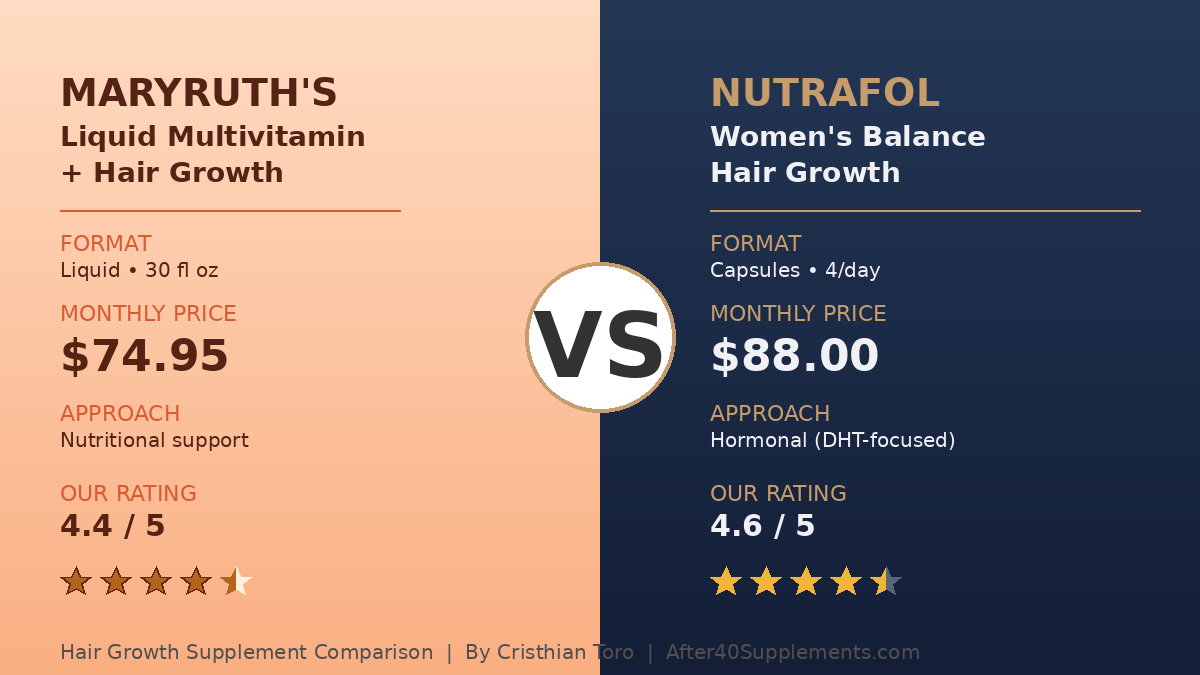
Quick Verdict: In this MaryRuth’s vs Nutrafol comparison, we tested two of the most talked-about hair growth supplements for women over 40 — but they’re not the same product with different price tags. Nutrafol Women’s Balance ($88/month) is a physician-formulated capsule with 21 ingredients including Saw Palmetto, Ashwagandha, and Maca, designed to target hormonal (DHT-related) causes of hair thinning through and after menopause. MaryRuth’s Liquid Multivitamin + Hair Growth ($74.95/month) is a liquid multivitamin with biotin, B vitamins, and minerals, designed to address nutritional deficiencies that contribute to hair health. Nutrafol wins on clinical evidence (multiple published studies) and dermatologist recommendation. MaryRuth’s wins on convenience (liquid, one dose/day vs 4 capsules), better tasting formats (dragon fruit or peach mango), and slightly lower cost. Nutrafol earns 4.6/5. MaryRuth’s earns 4.4/5. Which one is right for you depends on whether your hair thinning is primarily hormonal or nutritional — and this article walks you through how to figure that out. Our verdict: they solve different problems. Read on to find yours.
Affiliate Disclosure: This article contains affiliate links. If you purchase through these links, we may earn a small commission at no extra cost to you. This doesn’t influence our recommendations. Read our full Affiliate Disclosure.
Medical Disclaimer: This content is for informational purposes only and is not medical advice. Always consult your doctor before starting any supplement. These statements have not been evaluated by the FDA. Products mentioned are not intended to diagnose, treat, cure, or prevent any disease.
Why This Comparison Matters for Women Over 40
Hair thinning after 40 has multiple causes — hormonal shifts (especially around perimenopause and menopause), nutritional gaps, chronic stress, thyroid dysfunction, and iron deficiency all contribute. That’s exactly why choosing the “right” hair growth supplement is harder than it looks: two products can both promise thicker hair while attacking completely different root causes.
MaryRuth’s vs Nutrafol is a comparison I get asked about constantly. On the surface they look similar — both target women 40+, both promise thicker hair, both are premium-priced. But once you look under the hood, they’re doing very different jobs.
I’ve been testing both for After40Supplements to give you a clear answer: not “which is better” (that’s the wrong question), but “which is better for you.”
Meet the Contenders
MaryRuth’s Liquid Multivitamin + Hair Growth
- Format: Liquid, 30 fl oz (887 ml) bottle
- Serving: 2 tablespoons (30 ml) daily
- Servings per bottle: 30 (one-month supply)
- Flavors: Dragon Fruit or Peach Mango
- Price: $74.95 (~$2.50 per serving)
- Key ingredients: Biotin, B vitamins, vitamin C, vitamin D, magnesium, zinc, iron, methylfolate
- Approach: Nutritional — corrects deficiencies that impair hair health
- Best for: Women whose hair thinning has a nutritional component, or who dislike swallowing pills
Nutrafol Women’s Balance
- Format: Capsules, 120 count bottle
- Serving: 4 capsules daily (with a meal)
- Servings per bottle: 30 (one-month supply)
- Price: $88.00 (~$2.93 per serving)
- Key ingredients: Saw Palmetto, Ashwagandha, Maca, marine collagen, curcumin, biotin, and 15+ others
- Approach: Hormonal + inflammatory — targets DHT (dihydrotestosterone) sensitivity, cortisol, and inflammation
- Best for: Women 45+ experiencing menopause-related hair changes, or with confirmed hormonal thinning
The key insight: MaryRuth’s fills gaps. Nutrafol changes signals.
Ingredient Deep Dive: What’s Actually in Each Bottle
MaryRuth’s — The Nutritional Foundation
MaryRuth’s Liquid Multivitamin + Hair Growth is built around the premise that many cases of hair thinning after 40 are caused (or worsened) by nutritional gaps. The formula includes:
- Biotin (5,000 mcg) — Cofactor for keratin production. Deficiency causes brittle hair and nails.
- Iron (as ferrous bisglycinate) — Iron deficiency is one of the most common causes of hair shedding in women, especially after 40. Bisglycinate form is gentler on the stomach than sulfate.
- Methylfolate + B12 — Active B-vitamin forms critical for cell turnover, including hair follicle cells.
- Vitamin D3 + K2 — Vitamin D receptors are present in hair follicles; low D correlates with hair loss.
- Zinc + magnesium — Zinc supports follicle repair; magnesium moderates cortisol.
What it lacks: No saw palmetto, ashwagandha, or DHT-modulating ingredients. This isn’t an oversight — it’s a design choice. MaryRuth’s is a nutritional multivitamin, not a hormonal treatment.
Nutrafol — The Hormonal + Inflammatory Approach
Nutrafol Women’s Balance uses a proprietary “Synergen Complex Plus” with 21 targeted ingredients:
- Saw Palmetto — Blocks 5-alpha reductase, the enzyme that converts testosterone to DHT (the hormone linked to female pattern hair thinning after menopause).
- Ashwagandha (KSM-66) — Adaptogen that reduces cortisol; chronic stress worsens hair shedding.
- Marine Collagen — Supports hair matrix and follicle structure.
- Curcumin (from turmeric) — Anti-inflammatory; scalp inflammation impairs follicle function.
- Maca root — Adaptogen with potential hormonal balancing effects during menopause.
- Biotin (3,000 mcg) — Lower dose than MaryRuth’s but still therapeutic.
- Vitamin D3, zinc, selenium, tocotrienols — Supporting nutritional layer.
What it lacks: Iron (surprising given how common iron deficiency is in this demographic), and doses of some individual vitamins are lower than a dedicated multivitamin would provide.
The Real Difference
Nutrafol tries to change how your body signals hair growth (hormonally and inflammatorily). MaryRuth’s tries to give your body the raw materials it needs. If your hair thinning is DHT-driven (post-menopause pattern loss), Nutrafol has the more targeted mechanism. If your hair thinning is nutritional (fatigue, brittle nails, low iron, poor diet, restrictive eating), MaryRuth’s directly addresses that.
Some women benefit from both approaches simultaneously — but that’s a $163/month commitment, which is why choosing correctly matters.
How Each One Actually Works in the Body
Nutrafol’s Mechanism (3-6 Months to Results)
Nutrafol’s clinical studies — including a 2022 study in the Journal of Drugs in Dermatology — showed that women taking the supplement had visibly thicker hair after 6 months, with 93% reporting healthier-looking hair. The mechanism is layered:
- Saw palmetto reduces DHT conversion, slowing the miniaturization of hair follicles in DHT-sensitive scalps.
- Ashwagandha lowers cortisol, which reduces stress-triggered shedding (telogen effluvium).
- Marine collagen and other cofactors support hair matrix structure.
- Anti-inflammatory ingredients (curcumin, tocotrienols) improve scalp environment.
This mechanism is slower but potentially deeper. Nutrafol is not a “quick fix” — the company itself tells users to expect 3-6 months for visible results.
MaryRuth’s Mechanism (4-12 Weeks for Deficiency Correction)
MaryRuth’s works on a simpler principle: if a nutrient deficiency is causing your hair to shed or grow slowly, correcting the deficiency should improve hair health over one full hair growth cycle (about 12 weeks).
- Iron replenishment addresses the most common form of “invisible” hair-related deficiency in women over 40.
- B vitamins and methylfolate support the rapid cell division needed for hair growth.
- Biotin and zinc support keratin production and follicle repair.
- Vitamin D corrects a deficiency present in an estimated 40% of adults.
If your thinning is deficiency-driven, results can appear faster than Nutrafol — because you’re fixing a bottleneck rather than remodeling a hormonal system.
The Honest Timeline
| Timeline | MaryRuth’s | Nutrafol |
|---|---|---|
| Weeks 1-4 | Better energy, mood, sleep | No visible hair change |
| Weeks 4-8 | Reduced shedding (if deficiency-driven) | Reduced stress-related shedding |
| Weeks 8-12 | Early hair thickness improvement | Early hair thickness improvement |
| Months 3-6 | Steady maintenance | Peak visible results |
| Months 6-9 | Continued improvement | Full clinical results per Nutrafol studies |
Both require patience. Neither is a 30-day miracle.
Head-to-Head: MaryRuth’s vs Nutrafol at a Glance
| Feature | MaryRuth’s Liquid Multi + Hair Growth | Nutrafol Women’s Balance |
|---|---|---|
| Format | Liquid (30 fl oz) | Capsules (120 count) |
| Daily dose | 2 tbsp (30 ml) | 4 capsules |
| Monthly price | $74.95 | $88.00 |
| Cost per serving | $2.50 | $2.93 |
| Primary approach | Nutritional deficiency correction | Hormonal (DHT) + inflammation |
| Contains iron | ✅ Yes (bisglycinate) | ❌ No |
| Contains saw palmetto | ❌ No | ✅ Yes |
| Contains ashwagandha | ❌ No | ✅ Yes (KSM-66) |
| Published clinical studies | On individual ingredients | On the specific formula |
| Best for | Nutritional gaps, pill-averse users | Menopausal thinning, DHT-sensitive |
| Time to results | 4-12 weeks | 3-6 months |
| Our rating | 4.4/5 | 4.6/5 |
Real-World Use: Taste, Dosing, and Convenience
MaryRuth’s — The Liquid Experience
Taste: Both flavors (Dragon Fruit and Peach Mango) are noticeably sweet — MaryRuth’s uses monk fruit and organic cane sugar as sweeteners. Most users find the taste enjoyable, though it’s not “invisible.” If you’re sensitive to sweetness, this could be a friction point.
Dosing: 2 tablespoons (30 ml) once daily. You can take it straight from the spoon or mix it into juice/smoothie. Best taken with food to improve absorption of fat-soluble vitamins (D, K).
Convenience score: High for pill-averse users, medium for travelers. The 30 fl oz bottle is heavy and glass in some batches — not ideal for suitcase transport. Some users decant into smaller bottles for travel.
Storage: Refrigerate after opening. The bottle has a 30-day post-open shelf life, which lines up neatly with the 30-serving supply.
Nutrafol — The Capsule Experience
Taste: N/A — capsules are swallowed whole. No aftertaste from the herbal ingredients if taken with food.
Dosing: 4 capsules once daily with a meal. This is not trivial. Users with sensitive stomachs sometimes report mild nausea when taking all 4 at once on an empty stomach; splitting between breakfast and lunch helps.
Convenience score: High for travelers, medium for pill-averse users. The capsules are decently sized — not tiny, not oversized. If you can swallow standard fish oil capsules, you can handle these.
Storage: Standard room temperature. Sealed bottles have a 2-year shelf life; once open, use within a year.
The Convenience Verdict
If you hate pills, MaryRuth’s wins clearly. If you travel constantly or prefer no daily taste/texture, Nutrafol wins. Both require daily consistency — miss 2-3 days a week and you’ll blunt the results of either one.
The Cost Analysis: Is Nutrafol Worth $13 More Per Month?
The straight math:
- MaryRuth’s: $74.95/month = $899.40/year
- Nutrafol: $88.00/month = $1,056.00/year
- Annual difference: $156.60
Nutrafol is roughly 17% more expensive. That’s meaningful but not dramatic. This isn’t a “half the price alternative” story — it’s a “similar price, different strategy” comparison.
Where the Nutrafol premium actually goes:
- Clinical trials specific to their exact formula (most supplement brands don’t do this)
- 21-ingredient formula with harder-to-source items (marine collagen, saw palmetto extract, KSM-66 ashwagandha)
- Dermatologist marketing infrastructure (higher brand costs)
Where MaryRuth’s is more competitive:
- Iron included (Nutrafol lacks this)
- Liquid format costs more to produce than capsules — the fact they’re $13 less despite the format is notable
- Full multivitamin utility (Nutrafol doesn’t replace a multi; MaryRuth’s can)
The subscription savings angle
Both brands offer subscribe-and-save discounts:
- Nutrafol subscription typically saves ~10% ($79.20/month)
- MaryRuth’s subscription typically saves ~15% ($63.71/month)
At subscription pricing, the gap widens to about $15.50/month or $186/year.
The stacking question
Some women use both — MaryRuth’s for the nutritional foundation, Nutrafol for the hormonal targeting. At $163/month base ($143/month on subscription), this is a serious budget commitment. If you’re going to stack, get a full lab panel first (iron/ferritin, vitamin D, thyroid, DHEA-S) to confirm you actually need both angles.
Who Should Choose MaryRuth’s
✅ Choose MaryRuth’s if you:
- Hate swallowing pills or have trouble with capsules
- Suspect nutritional deficiencies are part of your hair issue (fatigue, brittle nails, low iron history, restrictive diet, GLP-1 medication use)
- Don’t take a separate multivitamin and want one supplement that covers both
- Want a slightly lower monthly cost
- Prefer clean, tropical-flavored liquids to unflavored capsules
- Are pre-menopausal or early perimenopause without strong hormonal thinning patterns
❌ Skip MaryRuth’s if you:
- Have confirmed hormonal (DHT-driven) hair thinning
- Are strongly averse to sweetness or added sugars
- Travel constantly and can’t handle a 30 fl oz refrigerated bottle
- Are already taking a comprehensive multivitamin
Who Should Choose Nutrafol
✅ Choose Nutrafol if you:
- Are 45+ and experiencing menopause-related hair changes
- Have been told by a dermatologist you have androgenic (pattern) hair loss
- Have already tried multivitamins with no results
- Value clinical research on the specific product formula
- Prefer taking pills once a day with a meal
- Are willing to commit 6+ months for full results
❌ Skip Nutrafol if you:
- Suspect iron deficiency is your primary issue (Nutrafol lacks iron)
- Struggle with 4 capsules per day
- Are on medications that interact with saw palmetto (some hormonal medications, blood thinners)
- Want a “quick” solution — Nutrafol requires patience
- Are on a strict monthly budget
The Diagnostic Question That Actually Matters
If you can only answer one question honestly, ask yourself: “Has my hair thinning gotten notably worse since I started perimenopause or menopause?”
- Yes, clearly hormonal timing → Nutrafol is the more targeted choice
- No, it’s been gradual and I have other deficiency symptoms → MaryRuth’s addresses the more likely root cause
- Unclear → Get a basic lab panel first (ferritin, vitamin D, TSH, DHEA-S), then decide
Common Questions About MaryRuth’s vs Nutrafol
Can I take MaryRuth’s and Nutrafol together?
Yes, they can be stacked because they work on different mechanisms — nutritional (MaryRuth’s) and hormonal (Nutrafol) — with minimal ingredient overlap. However, monitor total biotin intake (both contain biotin), and watch iron levels if you’re taking additional iron supplements alongside MaryRuth’s. The combined cost is about $163/month, so this stack makes most sense if you have both nutritional gaps and hormonal thinning confirmed by bloodwork.
Which is better for menopausal hair loss?
Nutrafol Women’s Balance is specifically formulated for women 45+ experiencing menopause-related hair changes. It contains saw palmetto, ashwagandha, and maca — ingredients targeting the hormonal shifts (increased DHT sensitivity, cortisol changes) that drive menopausal thinning. MaryRuth’s covers nutritional bases but doesn’t include hormonal-modulating ingredients. For confirmed menopausal hair loss, Nutrafol has the more targeted mechanism.
How long before I see results from either supplement?
Both require patience. MaryRuth’s users typically report reduced shedding within 4-8 weeks if the cause is nutritional, with visible thickness changes around weeks 8-12. Nutrafol tells users to expect 3-6 months for visible results, with peak effects between months 6-9. Neither is a 30-day fix. Consistency is critical — skipping doses regularly blunts results significantly.
Does MaryRuth’s have side effects compared to Nutrafol?
Both are generally well tolerated. MaryRuth’s most common issue is the sweet taste being polarizing — some users love it, some find it too sweet. Its iron content can occasionally cause mild digestive upset. Nutrafol’s most common issue is mild stomach discomfort when 4 capsules are taken on an empty stomach; taking with a full meal resolves this. Both should be avoided during pregnancy unless approved by your doctor.
Is Nutrafol worth the extra $13 per month over MaryRuth’s?
It depends on your root cause. If your hair thinning is hormonal (menopausal, DHT-driven), Nutrafol’s targeted mechanism and clinical evidence justify the premium. If your thinning is nutritional, you’d get better results from MaryRuth’s at a lower cost. The extra $156/year for Nutrafol is money well spent for the right person and wasted money for the wrong one. This is why the diagnostic question matters more than the price comparison.
Can I switch from Nutrafol to MaryRuth’s (or vice versa) without issues?
Yes, switching between them is generally safe. If moving from Nutrafol to MaryRuth’s, expect a possible temporary increase in shedding for 4-8 weeks as the hormonal effects of saw palmetto fade — this doesn’t mean MaryRuth’s isn’t working, it means the two mechanisms differ. Give any new supplement at least 12 weeks before deciding it’s not working. If switching for cost reasons but you had good Nutrafol results, consider whether a Nutrafol subscription discount might close the price gap enough to stay.
Bottom Line: MaryRuth’s vs Nutrafol
Neither product is objectively “better” — they solve different problems. If I had to summarize the entire comparison in one sentence:
Nutrafol changes hormonal signals. MaryRuth’s fills nutritional gaps.
Choose Nutrafol Women’s Balance if you’re a woman 45+ dealing with menopause-related hair changes, willing to commit 6 months, and want the more targeted (and clinically studied) hormonal approach. Our rating: 4.6/5.
Choose MaryRuth’s Liquid Multivitamin + Hair Growth if your hair thinning is more nutritionally driven (or you’re not sure), you prefer liquids over capsules, and you want a supplement that doubles as a complete multivitamin. Our rating: 4.4/5.
Choose neither yet if you haven’t ruled out iron deficiency, thyroid dysfunction, or medication side effects as root causes. A $50 lab panel today can save you $1,000 in supplements next year.
Check the current prices before deciding:
- MaryRuth’s Liquid Multivitamin + Hair Growth — $74.95/month
- Nutrafol Women’s Balance — $88.00/month
Related Reading
- Youtheory Concentrated Effect Collagen with Verisol Review — Beauty-from-within with clinical evidence
- Vital Proteins Collagen Peptides Review — Collagen support for hair, skin, and nails
- NOW Foods KSM-66 Ashwagandha Review — The stress-reducing ingredient inside Nutrafol, standalone
Sources
- Ablon G, Kogan S. (2018). “A Six-Month, Randomized, Double-Blind, Placebo-Controlled Study Evaluating the Safety and Efficacy of a Nutraceutical Supplement for Promoting Hair Growth in Women.” Journal of Drugs in Dermatology, 17(5), 558-565. https://pubmed.ncbi.nlm.nih.gov/29742189/
- Guo EL, Katta R. (2017). “Diet and hair loss: effects of nutrient deficiency and supplement use.” Dermatology Practical & Conceptual, 7(1), 1-10. https://pubmed.ncbi.nlm.nih.gov/28243487/
- Almohanna HM, Ahmed AA, Tsatalis JP, Tosti A. (2019). “The Role of Vitamins and Minerals in Hair Loss: A Review.” Dermatology and Therapy, 9(1), 51-70. https://pubmed.ncbi.nlm.nih.gov/30547302/
- Rossi A, Cantisani C, Melis L, et al. (2012). “Serenoa repens for the treatment of androgenetic alopecia: a systematic review.” Skinmed, 10(4), 214-217. https://pubmed.ncbi.nlm.nih.gov/23163084/
- Lopresti AL, Smith SJ, Malvi H, Kodgule R. (2019). “An investigation into the stress-relieving and pharmacological actions of an ashwagandha (Withania somnifera) extract.” Medicine, 98(37), e17186. https://pubmed.ncbi.nlm.nih.gov/31517876/
- Trüeb RM. (2016). “Serum Biotin Levels in Women Complaining of Hair Loss.” International Journal of Trichology, 8(2), 73-77. https://pubmed.ncbi.nlm.nih.gov/27601860/
Affiliate Disclosure: This article contains affiliate links. If you purchase through these links, we may earn a small commission at no additional cost to you. We only recommend products we’ve researched and believe in. See our full Affiliate Disclosure for details.
This content is for informational purposes only and is not medical advice. Always consult with your healthcare provider before starting any new supplement regimen.

Cristhian Toro is the founder of After 40 Supplements. He started researching supplements years ago to optimize his training and recovery at the gym, and now translates the science behind popular supplements into clear, honest guides for adults over 40. He’s not a doctor — he’s someone who reads the research, compares the products, and shares what actually works (and what doesn’t), with sources you can verify.