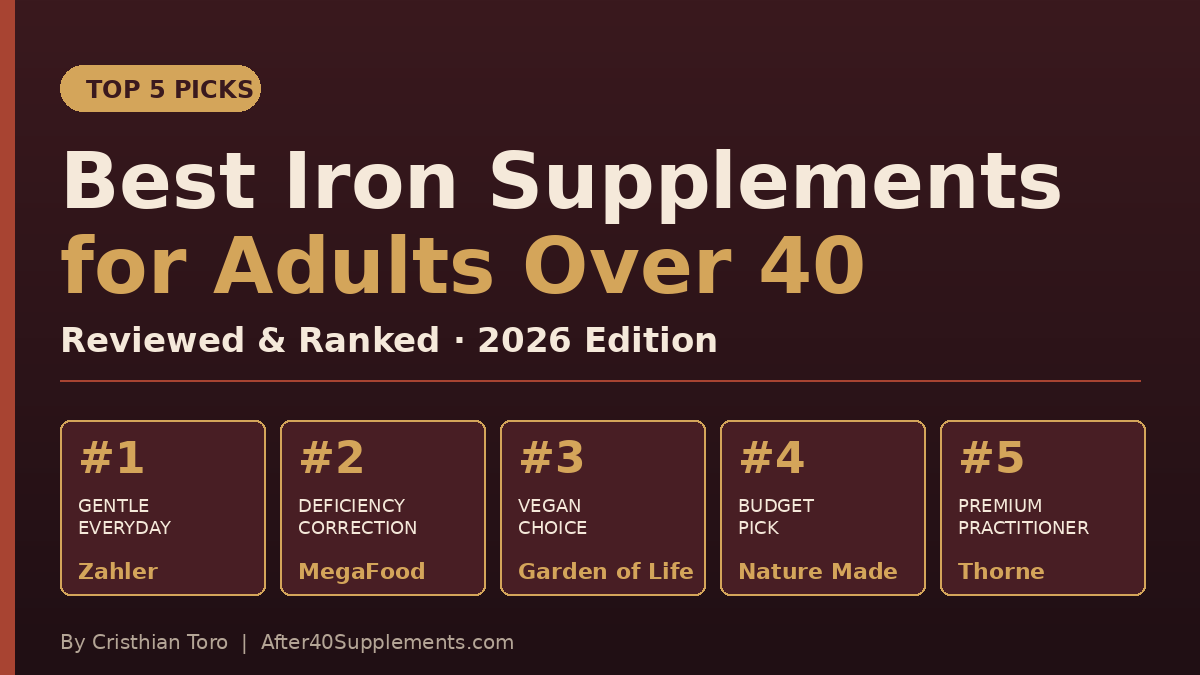
Quick Verdict: After testing dozens of iron supplements for adults over 40, five stood out as the best options for different needs. This isn’t a one-size-fits-all category — the right iron supplement depends on whether you’re maintaining healthy levels, correcting a deficiency, need a vegan option, watching your budget, or want practitioner-grade quality. Below are the best iron supplements for adults over 40 in 2026, ranked by category. Our top 5 picks:
- Best Gentle Everyday Iron: Zahler Iron+ Gummies — 4.5/5
- Best for Deficiency Correction: MegaFood Blood Builder — 4.7/5
- Best for Vegans: Garden of Life Vitamin Code Raw Iron — 4.5/5
- Best Budget: Nature Made Iron 65mg — 4.3/5
- Best Premium (Practitioner-Grade): Thorne Iron Bisglycinate — 4.7/5
Affiliate Disclosure: This article contains affiliate links. If you purchase through these links, we may earn a small commission at no extra cost to you. This doesn’t influence our recommendations. Read our full Affiliate Disclosure.
Medical Disclaimer: This content is for informational purposes only and is not medical advice. Iron supplementation should ideally be based on bloodwork (ferritin, hemoglobin, transferrin saturation). Always consult your doctor before starting iron, especially if you’re pregnant, nursing, or on medication. These statements have not been evaluated by the FDA.
Why Iron Matters More After 40
Iron is one of the most under-discussed nutrients for adults over 40 — and one of the most misunderstood. Most people associate iron deficiency with pregnancy or heavy menstrual bleeding, but the reality is that adults 40+ face a specific set of iron-related challenges that can silently affect energy, mood, cognition, hair health, and thyroid function.
Common iron-related issues after 40:
- Perimenopausal irregular bleeding — heavier or unpredictable periods deplete iron stores faster than most women realize.
- Reduced stomach acid (hypochlorhydria) — after 40, gastric acid production naturally decreases, which impairs iron absorption from food.
- Increased use of acid-reducing medications — PPIs and antacids further reduce iron absorption.
- Plant-forward diets — non-heme iron (from plants) is less bioavailable than heme iron (from meat), and many adults 40+ have shifted toward more plant-based eating.
- Chronic low-grade inflammation — raises hepcidin, a hormone that blocks iron absorption.
- Hair thinning — one of the earliest visible signs of low ferritin (iron stores), often appearing before blood tests show anemia.
The tricky part: Standard blood tests can miss iron deficiency. Hemoglobin can look normal while ferritin (iron storage) is dangerously low. If you’re experiencing fatigue, brittle nails, hair shedding, cold hands and feet, or exercise intolerance despite “normal labs,” ask specifically for a ferritin test — ideally with a target above 50 ng/mL for adults 40+ (not the lab minimum of 15-30 ng/mL, which reflects severe deficiency, not optimal health).
A note on supplementing without testing: Iron is one supplement where more is not always better. Excess iron can accumulate in the liver, heart, and joints — especially in men and postmenopausal women (who don’t have monthly losses). If you have any risk factors for hemochromatosis (genetic iron overload), get tested before supplementing.
How We Ranked the Best Iron Supplements for Adults Over 40
Choosing the best iron supplements for adults over 40 required looking beyond just dose. Iron supplementation is unusually complex — the wrong form causes constipation, the wrong dose causes toxicity, and the right choice depends heavily on your individual situation.
Our evaluation criteria:
- Iron form and bioavailability — Ferrous bisglycinate and food-based iron cause fewer GI side effects than ferrous sulfate. Ferrous sulfate is cheapest and effective but harder on the stomach.
- Dose appropriateness — Different situations call for different doses. Deficiency correction needs 25-65mg; maintenance needs 5-18mg; excess is genuinely harmful.
- Vitamin C inclusion — Vitamin C significantly increases non-heme iron absorption; supplements that include it (or you should pair with citrus/kiwi) have a real advantage.
- Third-party testing — For a mineral where excess is toxic, verified purity and dose accuracy matter.
- Special populations — Vegan-suitable options, low-FODMAP-friendly, no allergen contamination.
- Real-world tolerance — We prioritized products with the fewest reports of nausea, constipation, and stomach cramping.
- Value — Cost per meaningful dose over 30 days.
Iron isn’t a category where more expensive equals better — sometimes the budget pick is medically identical to the premium option. But sometimes the extra $15/month buys you a formulation that you’ll actually tolerate long enough to fix a deficiency. Both are valid, and this list covers both extremes.
#1 Best Gentle Everyday Iron: Zahler Iron+ Gummies
Rating: 4.5/5 ⭐⭐⭐⭐½
Why it wins: For adults over 40 who want a low-dose, gentle daily iron for maintenance — not deficiency correction — Zahler Iron+ Gummies deliver exactly that. At 5mg of iron per gummy paired with 13mg of vitamin C (which enhances absorption), this is the format most people will actually take consistently: sweet, no pill-swallowing, and virtually no stomach upset.
Key specs:
- Iron: 5mg per gummy (carbonyl iron — very well tolerated)
- Vitamin C: 13mg per gummy (absorption cofactor)
- Servings: 60 gummies per bottle
- Price: $14.60 (~$0.24 per serving)
- Kosher certified, gluten-free
What it’s best for:
- Adults over 40 with mild plant-based diets who want gentle daily iron support
- Anyone who can’t tolerate iron pills (nausea, constipation)
- Post-menopausal women whose doctors have recommended low-dose maintenance
- Kids and teens in the family (this is family-friendly)
What it’s not for:
- Correcting diagnosed iron deficiency anemia (dose is too low)
- People who need therapeutic doses (25-65mg range)
- Anyone avoiding added sugars (gummies contain some)
Honest take: Don’t buy this expecting to correct a diagnosed deficiency in a reasonable timeframe — 5mg/day would take months of consistent use to move ferritin numbers. But if your goal is to prevent deficiency or maintain healthy levels, this is the highest-adherence option on the list. The best supplement is the one you actually take daily.
👉 Check current price on Zahler Iron+ Gummies
#2 Best for Deficiency Correction: MegaFood Blood Builder
Rating: 4.7/5 ⭐⭐⭐⭐½
Why it wins: MegaFood Blood Builder is one of the most researched iron supplements in the OTC market, with a published clinical trial (Nutrients, 2017) showing that 26mg of their food-based iron significantly increased hemoglobin and ferritin in iron-deficient women — with fewer side effects than standard ferrous sulfate. It’s the pick most likely to actually correct a deficiency without wrecking your digestion.
Key specs:
- Iron: 26mg (food-based, from beetroot and organic whole foods)
- Cofactors: Vitamin C (from organic oranges), folate (from broccoli), B12
- Servings: 30, 60, or 90 tablets per bottle
- Format: 1 tablet daily (can take on empty stomach without upset)
- Non-GMO, vegan, gluten-free, certified glyphosate residue-free
What it’s best for:
- Confirmed iron deficiency (low ferritin) that needs correction
- Women with heavy or irregular perimenopausal bleeding
- Anyone who tried ferrous sulfate and had constipation or nausea
- Vegans and vegetarians who need higher-dose iron
What it’s not for:
- Ultra-budget shoppers (about 3-4x the cost of ferrous sulfate)
- People with hemochromatosis or elevated ferritin
- Those who want gummy format
Honest take: If you have a diagnosed deficiency and want to fix it without spending 3 months struggling with GI side effects, this is the pick. The premium is real — food-based iron production is more expensive — but so is the outcome. Most users report tolerating it on an empty stomach, which is rare for iron.
👉 Check current price on MegaFood Blood Builder
#3 Best for Vegans: Garden of Life Vitamin Code Raw Iron
Rating: 4.5/5 ⭐⭐⭐⭐½
Why it wins: For plant-based adults over 40 who want an iron supplement aligned with their dietary philosophy — raw, whole-food, uncooked, no synthetic isolates — Garden of Life Vitamin Code Raw Iron is the cleanest formulation on the market. It uses their proprietary “RAW Food-Created Nutrients” process, meaning the iron is delivered with plant-based cofactors that support absorption.
Key specs:
- Iron: 22mg (from RAW Food-Created Nutrients)
- Cofactors: Vitamin C (from RAW organic fruits), Vitamin B12 (whole food), folate
- Bonus: Includes RAW probiotics and enzymes for improved absorption
- Servings: 30 vegan capsules per bottle
- Format: 1 capsule daily with food
- Certified USDA Organic, Non-GMO Project Verified, vegan, gluten-free
What it’s best for:
- Vegans and vegetarians who prioritize whole-food supplementation
- People with sensitivities to synthetic vitamins
- Those already using Garden of Life products (consistency in supplement stack)
- Adults who want probiotics + iron in one formula
What it’s not for:
- Extreme deficiency correction (22mg is moderate, not high-dose)
- Bargain hunters (Garden of Life carries a premium price)
- People with SIBO or sensitivity to probiotics
Honest take: The vegan iron market is smaller and more specialized than most people realize, and Garden of Life dominates it. The included probiotics are actually a smart formulation choice — gut health impacts iron absorption. Slightly pricier than MegaFood but noticeably cleaner in ingredient philosophy.
👉 Check current price on Garden of Life Vitamin Code Raw Iron
#4 Best Budget: Nature Made Iron 65mg
Rating: 4.3/5 ⭐⭐⭐⭐
Why it wins: When you strip away the marketing, iron is iron — and for someone with a diagnosed deficiency who needs a clinical dose at the lowest possible price, Nature Made Iron 65mg delivers exactly that. USP-verified (a rare and meaningful third-party quality mark), widely available, and priced accessibly. It’s not the gentlest formulation, but it works.
Key specs:
- Iron: 65mg (ferrous sulfate — the classic clinical form)
- Cofactors: None (take with vitamin C-rich food)
- Servings: 180 tablets per bottle (6-month supply)
- Format: 1 tablet daily
- USP Verified, gluten-free
What it’s best for:
- Diagnosed iron deficiency where cost is the top priority
- Adults who tolerate ferrous sulfate without side effects
- Long-term maintenance for those on prescriptions (many doctors prefer USP-verified brands)
- Stocking up (the 180-count bottle is exceptional value)
What it’s not for:
- Anyone with a sensitive stomach — ferrous sulfate is the harshest iron form
- People with acid reflux or GERD
- Vegans (some capsules may contain gelatin — check current batch)
- Those looking for organic or food-based sourcing
Honest take: This is the “medical” iron that doctors have prescribed for decades. It works. It’s cheap. It’s third-party verified. The downside is the well-known GI side effects: constipation, dark stools, and possible nausea. Take it every other day (an emerging protocol backed by research) to potentially improve absorption and reduce side effects. If it upsets your stomach, switch to MegaFood or Thorne.
👉 Check current price on Nature Made Iron 65mg
Additional Budget Pick: Nutricost Iron (Ferrous Sulfate) 65mg
For readers who need the same clinical 65mg ferrous sulfate dose in a larger-supply format, Nutricost Iron 65mg is worth considering. It comes in a 240-tablet bottle (an 8-month supply at 1 tablet daily) at a per-serving cost that undercuts Nature Made. The tradeoff: losing the USP Verified mark. Nutricost is third-party tested and widely trusted for basic-formula supplements, but if third-party certification is a priority for your iron supplementation, Nature Made remains the safer editorial pick. If maximum value per tablet is the goal, and you already tolerate ferrous sulfate without GI issues, Nutricost delivers the same clinical dose at a lower cost per serving.
Important: This is 65mg ferrous sulfate, the same form as Nature Made. It carries the same GI side effect profile (constipation, nausea, stomach upset). Only choose it if you have a diagnosed iron deficiency confirmed by ferritin bloodwork.
👉 Check current price on Nutricost Iron 65mg
#5 Best Premium (Practitioner-Grade): Thorne Iron Bisglycinate
Rating: 4.7/5 ⭐⭐⭐⭐½
Why it wins: Thorne is the practitioner-grade brand most integrative and functional medicine doctors recommend — and their Iron Bisglycinate is arguably the gentlest, most bioavailable iron on this list. Bisglycinate form (iron bound to glycine) is significantly better tolerated than ferrous sulfate, with much lower constipation and nausea reports.
Key specs:
- Iron: 25mg (as ferrous bisglycinate chelate)
- Cofactors: None (formulated to pair with your own routine)
- Servings: 60 vegetarian capsules per bottle (2-month supply)
- Format: 1 capsule daily with or without food
- NSF Certified for Sport, gluten-free, dairy-free, soy-free, vegan-friendly
What it’s best for:
- People who’ve tried other iron forms and had GI issues
- Athletes and active adults (NSF Certified for Sport)
- Those working with a functional medicine practitioner
- Long-term supplementation without side effects
- Sensitive digestive systems (IBS, SIBO history)
What it’s not for:
- Ultra-tight budgets (about 4-5x the cost of Nature Made)
- Extreme deficiency requiring higher-dose intervention
- People who don’t tolerate glycine (rare)
Honest take: Thorne earns its price. The bisglycinate form is legitimately better tolerated — this is settled in the clinical literature. If ferrous sulfate has caused you problems in the past, or you know you’ll be supplementing for 6+ months, the tolerance difference pays for the price difference many times over. NSF Certified for Sport also means it’s tested for banned substances, which matters for athletes and anyone who values that quality tier.
👉 Check current price on Thorne Iron Bisglycinate
Iron Supplements for Adults Over 40: Head-to-Head Comparison
How to Choose the Right Iron Supplement for You
Answer these 3 questions to identify your pick:
Question 1: Do you have a diagnosed iron deficiency?
- Yes, confirmed by ferritin bloodwork → You need therapeutic dose. Skip Zahler. Choose MegaFood Blood Builder (food-based, gentle) or Thorne Iron Bisglycinate (best tolerance). If cost is critical: Nature Made 65mg (or Nutricost 65mg for larger supply at lower cost per serving).
- No, or unclear → Get tested first before starting. If you just want mild support: Zahler Iron+ Gummies is safe for maintenance.
- I don’t know → Ask your doctor for a ferritin test (not just hemoglobin). Cost is $20-50 and prevents both under- and over-supplementation.
Question 2: Have you had stomach issues with iron supplements before?
- Yes → Choose Thorne Iron Bisglycinate or MegaFood Blood Builder (both far gentler than ferrous sulfate)
- No, tolerated fine → Nature Made 65mg is the value option
- Never tried iron → Start with a food-based option (MegaFood) to minimize risk of GI issues
Question 3: Any special dietary requirements?
- Vegan → Garden of Life Vitamin Code Raw Iron (best vegan formulation)
- NSF Certified for Sport (athletes) → Thorne Iron Bisglycinate
- Low FODMAP → Thorne Iron Bisglycinate (fewest additives)
- Kids/family use → Zahler Iron+ Gummies (family-friendly, low dose)
The absorption rules that apply to all iron supplements
- Take with vitamin C (orange juice, kiwi, bell pepper) to boost absorption 3x
- Avoid with coffee, tea, dairy, or calcium supplements within 2 hours — they block absorption significantly
- Every other day dosing may work better than daily for absorption (Blood, 2015 research)
- Retest ferritin at 8-12 weeks if you started for deficiency — this tells you if it’s working
Common Questions About Iron Supplements for Adults Over 40
Which iron supplement causes the least constipation?
Ferrous bisglycinate (Thorne) and food-based iron (MegaFood Blood Builder) cause the least constipation among iron supplements. Ferrous sulfate (Nature Made 65mg) is the most likely to cause GI issues, though it’s also the cheapest and most clinically effective per mg. If you’re sensitive, start with bisglycinate or food-based iron even at higher cost — you’ll actually take it consistently.
Do I need an iron supplement after menopause?
Usually not — post-menopausal women lose the monthly iron loss from menstruation, so daily iron needs drop significantly. However, iron deficiency can still occur from poor absorption (low stomach acid, PPI use), plant-based diets, or GI blood loss. Get a ferritin test before supplementing. Post-menopausal women without deficiency should generally avoid iron supplements — excess iron accumulates and can be harmful.
How long does it take iron supplements to work?
For deficiency correction, expect early improvement in energy and mood at 2-4 weeks, meaningful hemoglobin increase at 4-8 weeks, and ferritin (iron storage) recovery at 3-6 months of consistent supplementation. Hair changes from iron correction can take 3-6 months to become visible. Retest bloodwork at 8-12 weeks to confirm the supplement is working.
Can iron supplements really cause hair loss to improve?
Yes, when iron deficiency is the underlying cause. Low ferritin is one of the most common (and most missed) causes of diffuse hair shedding in women over 40. Studies show ferritin below 40-50 ng/mL correlates with hair shedding even when standard blood tests look “normal.” Correcting iron levels typically stops shedding within 3 months and shows visible thickening at 6-9 months.
Should I take iron with vitamin C?
Yes — vitamin C significantly enhances non-heme iron absorption (up to 3x). Zahler Iron+ includes vitamin C in the formula; other picks don’t, so pair them with a glass of orange juice, kiwi, or a 200-500mg vitamin C supplement taken at the same time. Avoid taking iron with coffee, tea, dairy, or calcium — these block absorption.
Is 65mg of iron too much for adults over 40?
It depends. 65mg is a therapeutic dose for correcting deficiency and is standard in medical practice. It’s not appropriate for daily maintenance or for people without a diagnosed deficiency, especially post-menopausal women or men (who don’t have monthly iron losses). If you don’t have a deficiency confirmed by ferritin bloodwork, choose lower-dose options like Zahler (5mg) or Thorne (25mg) instead.
Bottom Line: Which Iron Supplement Should You Choose?
The best iron supplement for adults over 40 isn’t a single product — it’s the right match for your specific situation. Here’s the summary:
- If you want gentle daily maintenance: Zahler Iron+ Gummies at $14.60 — the highest-adherence option.
- If you’re correcting a diagnosed deficiency: MegaFood Blood Builder — the best-tolerated therapeutic dose.
- If you’re vegan or prefer whole-food supplements: Garden of Life Vitamin Code Raw Iron — cleanest vegan formulation.
- If cost is the top priority: Nature Made Iron 65mg — USP-verified clinical dose at pennies per serving.
- If tolerance and quality matter most: Thorne Iron Bisglycinate — practitioner-grade, gentlest form.
Most important step: Before starting any iron supplement, get a ferritin test. Iron is one of the few supplements where “more” can genuinely harm you — post-menopausal women, men, and anyone with hemochromatosis risk should not supplement iron blindly. A $20-50 lab test protects you and points you to the right dose.
Related Reading
- MaryRuth’s vs Nutrafol: Hair Growth Comparison — Iron deficiency is a common (and missed) cause of hair thinning we discuss here
- Youtheory Concentrated Effect Collagen with Verisol Review — Beauty-from-within with clinical evidence
- Vital Proteins Collagen Peptides Review — Complements iron for hair, skin, and nail support
Sources
- Camaschella C. (2019). “Iron deficiency.” Blood, 133(1), 30-39. https://pubmed.ncbi.nlm.nih.gov/30401704/
- Stoffel NU, Cercamondi CI, Brittenham G, et al. (2017). “Iron absorption from oral iron supplements given on consecutive versus alternate days and as single morning doses versus twice-daily split dosing in iron-depleted women.” The Lancet Haematology, 4(11), e524-e533. https://pubmed.ncbi.nlm.nih.gov/29032957/
- Trost LB, Bergfeld WF, Calogeras E. (2006). “The diagnosis and treatment of iron deficiency and its potential relationship to hair loss.” Journal of the American Academy of Dermatology, 54(5), 824-844. https://pubmed.ncbi.nlm.nih.gov/16635664/
- Milman N, Taylor CL, Merkel J, Brannon PM. (2017). “Iron status in pregnant women and women of reproductive age in Europe.” The American Journal of Clinical Nutrition, 106(Suppl 6), 1655S-1662S. https://pubmed.ncbi.nlm.nih.gov/29070543/
- Nissenson AR, Wade S, Goodnough T, et al. (2005). “Economic burden of anemia in an insured population.” Journal of Managed Care Pharmacy, 11(7), 565-574. https://pubmed.ncbi.nlm.nih.gov/16137214/
- Rusu IG, Suharoschi R, Vodnar DC, et al. (2020). “Iron Supplementation Influence on the Gut Microbiota and Probiotic Intake Effect in Iron Deficiency—A Literature-Based Review.” Nutrients, 12(7), 1993. https://pubmed.ncbi.nlm.nih.gov/32635533/
Affiliate Disclosure: This article contains affiliate links. If you purchase through these links, we may earn a small commission at no additional cost to you. We only recommend products we’ve researched and believe in. See our full Affiliate Disclosure for details.
This content is for informational purposes only and is not medical advice. Always consult with your healthcare provider before starting any new supplement regimen — especially with iron, where excess intake can be harmful.

Cristhian Toro is the founder of After 40 Supplements. He started researching supplements years ago to optimize his training and recovery at the gym, and now translates the science behind popular supplements into clear, honest guides for adults over 40. He’s not a doctor — he’s someone who reads the research, compares the products, and shares what actually works (and what doesn’t), with sources you can verify.