Affiliate Disclosure: This article contains affiliate links. If you purchase through these links, we may earn a small commission at no extra cost to you. This doesn’t influence our recommendations. Read our full Affiliate Disclosure.
Medical Disclaimer: This content is for informational purposes only and is not medical advice. Always consult your doctor before starting any supplement. These statements have not been evaluated by the FDA. Products mentioned are not intended to diagnose, treat, cure, or prevent any disease.
The best supplements for men over 40 aren’t the ones with flashy marketing — they’re the ones with real science behind them. Turning 40 hits different: your energy drops, recovery takes longer, and suddenly your joints have opinions about the weather. The supplement industry knows this — and they’re happy to sell you a cabinet full of pills you probably don’t need.
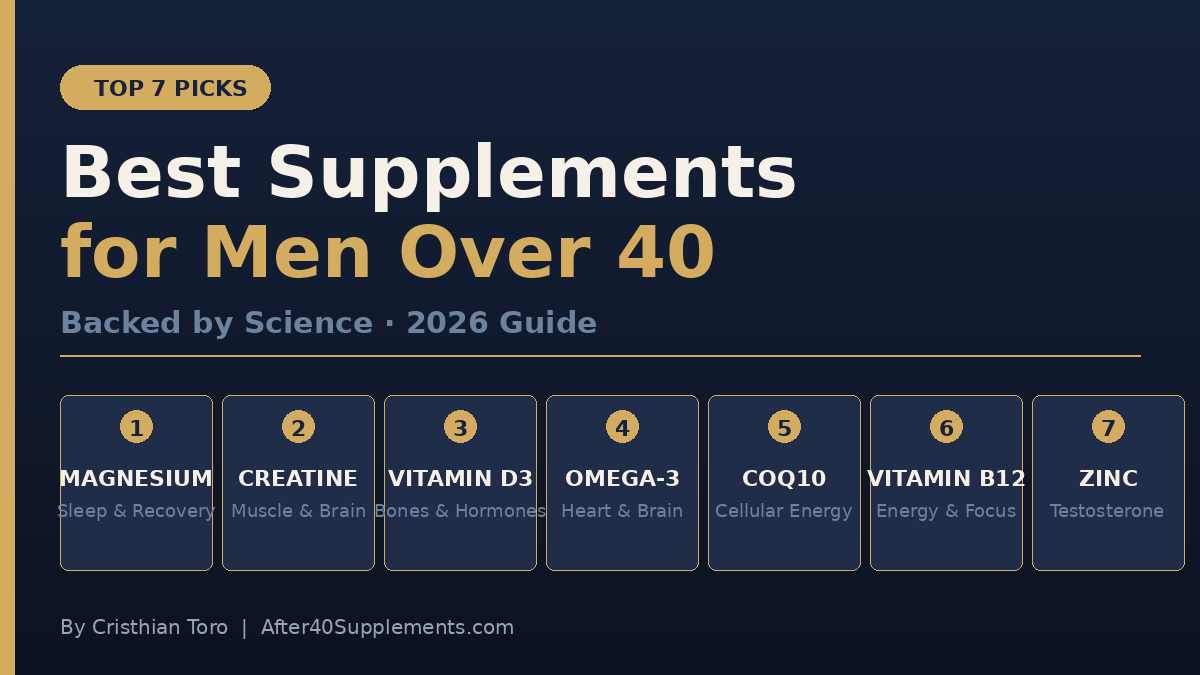
After weeks of research and testing, here are the 7 supplements that actually matter for men over 40, ranked by impact and backed by real science. No fluff, no sponsored picks.
I started researching supplements when I realized I was waking up tired every morning and my recovery after a simple weekend hike took days instead of hours. I’m not a doctor or a nutritionist — I’m someone going through the same changes you are, doing the homework so we can both make smarter choices.
Quick Summary: The 7 Best Supplements for Men Over 40
| Rank | Supplement | Best For | Top Brand Pick |
|---|---|---|---|
| 1 | Magnesium Glycinate | Sleep, muscle recovery, stress | Doctor’s Best High Absorption Magnesium Glycinate |
| 2 | Creatine Monohydrate | Muscle retention, brain health | Thorne Creatine |
| 3 | Vitamin D3 | Bone health, immunity, hormones | NatureWise Vitamin D3 2,000 IU (+ Nutricost D3 5,000 IU for correction dosing if deficient) |
| 4 | Omega-3 Fish Oil | Heart health, inflammation | Nordic Naturals Ultimate Omega |
| 5 | CoQ10 (Ubiquinol) | Heart health, energy | Qunol Mega Ubiquinol CoQ10 |
| 6 | Vitamin B12 | Energy, cognitive function | Jarrow Formulas Methyl B-12 |
| 7 | Zinc | Immunity, testosterone support | Garden of Life Vitamin Code Zinc |
Now let’s break down each one — what it does, why you need it after 40, and which brand to buy.
1. Magnesium Glycinate — The Foundation
Why it matters after 40: Magnesium is involved in over 300 biochemical reactions in your body, from muscle contraction to sleep regulation. The problem? Most men don’t get enough from diet alone, and absorption decreases with age. Low magnesium is linked to poor sleep, muscle cramps, anxiety, and even heart issues.
What the science says: A 2012 double-blind, placebo-controlled trial by Abbasi et al. in the Journal of Research in Medical Sciences found that magnesium supplementation significantly improved insomnia severity, sleep time, and sleep efficiency in older adults. A 2022 systematic review by Arab et al. in Biological Trace Element Research confirmed that magnesium supplementation improves subjective sleep quality, particularly at doses above 225mg.
Why glycinate specifically: Not all magnesium is equal. Magnesium oxide (the cheapest form) is poorly absorbed and often causes digestive issues. Magnesium glycinate is bonded to the amino acid glycine, which has its own calming properties. The result: better absorption, no stomach problems, and a mild relaxing effect that helps with sleep.
Our top pick: Doctor’s Best High Absorption Magnesium Glycinate
Doctor’s Best uses TRAACS, a patented chelation process from Albion Minerals that creates a highly stable, well-absorbed form of magnesium. Each two-capsule serving provides 200mg of elemental magnesium, and the tablets are free from gluten, soy, and GMOs. At around $15 per month, it’s one of the best values in quality magnesium.
What I like:
- Patented Albion Minerals chelation — gold standard absorption
- 200mg elemental magnesium per serving
- Gentle on stomach — minimal digestive issues
- Very affordable (~$15/month)
- Gluten-free, soy-free, non-GMO
What could be better:
- Requires 2 tablets per serving
- No NSF certification (though well-trusted brand)
- Tablet form, no powder option
Budget alternative: Premium alternative: Thorne Magnesium Bisglycinate (~$30-35/month) offers NSF Certified for Sport testing if you want the highest level of third-party verification.
Dosage: 200-400mg of elemental magnesium daily, taken in the evening for best sleep benefits.
2. Creatine Monohydrate — Not Just for Gym Bros
Why it matters after 40: Here’s something most men don’t know: creatine isn’t just for building muscle. It’s one of the most studied supplements in history, with strong evidence for muscle preservation, cognitive function, and energy production — all things that decline after 40.
By age 40, most men are losing about 1% of lean muscle mass per year. Creatine directly combats this by providing energy to muscle cells during contraction and supporting recovery between workouts.
What the science says: A 2017 meta-analysis by Chilibeck et al. in the Open Access Journal of Sports Medicine found that creatine plus resistance training significantly increased lean tissue mass (+1.37 kg) and upper and lower body strength in older adults across 22 RCTs. A 2018 systematic review by Avgerinos et al. in Experimental Gerontology confirmed cognitive benefits, particularly for short-term memory and reasoning under stress.
Why monohydrate: Despite fancy marketing for creatine HCL, buffered creatine, and other forms, monohydrate remains the most studied and effective form. It’s also the cheapest. Don’t overpay for marketing.
Our top pick: Thorne Creatine
Another Thorne product — and for good reason. Their creatine monohydrate is NSF Certified for Sport, micronized for better mixing, and contains zero fillers or additives.
What I like:
- NSF Certified for Sport
- Micronized for easy mixing
- Single ingredient — nothing else added
- Unflavored, mixes into anything
What could be better:
- More expensive than bulk options
- No scoop included
Budget alternative: Nutricost Creatine Monohydrate (~$15 for 100 servings) is third-party tested and one of the best values in the supplement industry.
Dosage: 5g daily. No need to load. Take it consistently — timing doesn’t matter as much as daily consistency.
I’ve been taking creatine monohydrate for about 3 years now, and it’s honestly one of the supplements that has made the biggest difference for me. Beyond the obvious gym benefits — better recovery, more consistent strength — what surprised me most was the mental clarity. I used to forget simple things like where I left my keys or what I walked into a room for. That’s noticeably improved. There’s also a steady energy boost that carries over into daily life, not jittery like caffeine, just a reliable baseline of feeling sharper and more capable throughout the day.
3. Vitamin D3 — The Sunshine Vitamin You’re Probably Missing
Why it matters after 40: Vitamin D functions more like a hormone than a vitamin, playing crucial roles in bone health, immune function, mood regulation, and testosterone production. After 40, your skin becomes less efficient at synthesizing vitamin D from sunlight, and if you work indoors (most of us), you’re almost certainly deficient.
What the science says: A 2005 meta-analysis by Bischoff-Ferrari et al. in JAMA found that vitamin D supplementation at 700-800 IU/day reduced hip fracture risk by 26% and nonvertebral fracture risk by 23% in older adults. It also supports immune function and may help maintain healthy testosterone levels.
Why D3 over D2: Vitamin D3 (cholecalciferol) is the form your body naturally produces from sunlight and is significantly more effective at raising blood levels than D2 (ergocalciferol).
Our top pick: NatureWise Vitamin D3
NatureWise delivers 2,000 IU per softgel in organic olive oil for better absorption (vitamin D is fat-soluble). It’s third-party tested, non-GMO, and gluten-free.
What I like:
- 2,000 IU per softgel — right in the sweet spot
- Organic olive oil base for better absorption
- Third-party tested for purity
- 360 softgels per bottle — a full year’s supply
What could be better:
- No vitamin K2 included (ideally you’d take D3 with K2)
- Softgel only, no liquid option
Pro tip: Consider pairing D3 with vitamin K2 (MK-7), which helps direct calcium to your bones instead of your arteries. Some brands sell D3+K2 combos.
High-dose alternative: Nutricost Vitamin D3 5,000 IU — for men whose 25(OH)D blood test comes back below 30 ng/mL, NatureWise’s 2,000 IU dose may not be enough to correct the deficiency in a reasonable timeframe. Nutricost delivers 5,000 IU per softgel with 240 softgels per bottle (8-month supply at ~$0.05/day — the same daily cost as the 2,000 IU option). It’s third-party tested, non-GMO, and gluten-free. Use it for the correction phase (8-12 weeks) until your levels are optimized, then step down to a maintenance dose. Not the right pick if you haven’t tested your levels — start with NatureWise 2,000 IU and get bloodwork done first.
Dosage: 1,000-2,000 IU daily for most men. Get your blood levels tested — optimal is 40-60 ng/mL. Some men need 4,000-5,000 IU to reach optimal levels.
4. Omega-3 Fish Oil — Your Heart and Brain Will Thank You
Why it matters after 40: Omega-3 fatty acids (EPA and DHA) are essential for heart health, brain function, joint comfort, and controlling inflammation. After 40, cardiovascular risk increases, and chronic inflammation becomes a bigger concern. Most men don’t eat enough fatty fish to get adequate omega-3s.
What the science says: A 2019 meta-analysis by Hu et al. in the Journal of the American Heart Association, analyzing 13 RCTs with 127,477 participants, found that omega-3 supplementation significantly reduced the risk of myocardial infarction, coronary heart disease events, and cardiovascular mortality. EPA and DHA also support brain cell membrane integrity, which may improve memory and mood.
What to look for: Total EPA+DHA per serving matters more than total fish oil. Many cheap brands advertise “1,000mg fish oil” but only contain 300mg of actual EPA+DHA. You want at least 1,000mg combined EPA+DHA daily.
Our top pick: Nordic Naturals Ultimate Omega
Nordic Naturals is widely regarded as the gold standard in fish oil. Their Ultimate Omega delivers 1,100mg of EPA+DHA per two-softgel serving in triglyceride form (better absorbed than ethyl ester).
What I like:
- High EPA+DHA concentration per serving
- Triglyceride form for superior absorption
- Third-party tested for purity and freshness
- No fishy burps (a common complaint with cheaper brands)
What could be better:
- Premium price (~$30-40/month)
- Large softgels may be hard to swallow
Budget alternative: Nutricost Omega-3 Fish Oil provides solid EPA+DHA content at a fraction of the price, though the concentration per pill is lower.
Dosage: 1,000-2,000mg combined EPA+DHA daily, taken with a meal containing fat.
5. CoQ10 (Ubiquinol) — The Energy Supplement Your Heart Needs
Why it matters after 40: Coenzyme Q10 is a compound your body produces naturally that plays a critical role in cellular energy production — especially in your heart, which is the most energy-demanding organ. The problem: CoQ10 production drops significantly after 40.
If you’re taking statin medications for cholesterol, this becomes even more important. Statins can deplete CoQ10 levels, which may contribute to the muscle pain and fatigue some men experience on these drugs.
Why ubiquinol over ubiquinone: CoQ10 comes in two forms: ubiquinone (oxidized) and ubiquinol (reduced/active). After 40, your body becomes less efficient at converting ubiquinone to ubiquinol. Taking ubiquinol directly is more bioavailable.
Our top pick: Qunol Mega Ubiquinol CoQ10
Qunol uses a patented water-soluble formula that’s clinically tested for absorption. Each softgel delivers 100mg of ubiquinol.
What I like:
- Active ubiquinol form (not ubiquinone)
- Water-soluble formula for better absorption
- Clinically tested bioavailability
- Widely available and reasonably priced
What could be better:
- Contains soy lecithin (issue for those with soy allergies)
- Softgels are fairly large
Dosage: 100-200mg daily with a meal containing fat. If you’re on statins, talk to your doctor about the right dose.
6. Vitamin B12 (Methylcobalamin) — Energy and Brain Power
Why it matters after 40: B12 is essential for energy production, red blood cell formation, and neurological function. Here’s the catch: after 40, your stomach produces less acid, which makes it harder to absorb B12 from food. Studies show that B12 deficiency becomes increasingly common with age and can lead to fatigue, brain fog, and even mood changes.
Why methylcobalamin: There are two main supplemental forms: cyanocobalamin (synthetic, cheaper) and methylcobalamin (active, natural form). Methylcobalamin is the form your body actually uses, so it bypasses the conversion step. This matters more as you age and conversion becomes less efficient.
Our top pick: Jarrow Formulas Methyl B-12
Jarrow’s sublingual (dissolves under the tongue) methylcobalamin lozenges deliver 1,000mcg in a form that bypasses digestive absorption entirely — ideal for men with reduced stomach acid.
What I like:
- Active methylcobalamin form
- Sublingual delivery for better absorption
- Pleasant cherry flavor
- Very affordable (~$8-10 for 100 lozenges)
What could be better:
- Contains sugar alcohols for flavoring
- Lozenge format isn’t for everyone
Dosage: 1,000-2,000mcg daily. Sublingual is preferred over capsules for men over 40 due to better absorption.
7. Zinc — Immunity and Hormonal Support
Why it matters after 40: Zinc plays a crucial role in immune function, wound healing, and hormone production. For men specifically, zinc is important for maintaining healthy testosterone levels. A landmark 1996 study by Prasad et al. in Nutrition found that zinc supplementation in marginally zinc-deficient elderly men nearly doubled serum testosterone levels over 6 months compared to baseline.
Why most men need it: Even mild zinc deficiency can impair immune response and reduce testosterone production. Men who exercise regularly lose zinc through sweat, and those who limit red meat intake may not get enough from diet alone.
Our top pick: Garden of Life Vitamin Code Zinc
Garden of Life uses a whole-food based formula that includes raw zinc (30mg) along with vitamin C and a raw probiotic and enzyme blend for better absorption.
What I like:
- Whole-food based, not synthetic
- Includes vitamin C for immune support
- Contains probiotics for gut health
- Vegan, gluten-free, non-GMO
What could be better:
- Requires 2 capsules per serving
- More expensive than basic zinc supplements
Budget alternative: Zinc picolinate from NOW Foods (~$8 for 120 capsules) is well-absorbed and no-frills.
Dosage: 11-15mg daily for maintenance. Don’t exceed 40mg unless directed by a doctor — too much zinc can interfere with copper absorption.
For a broader look at nutritional deficiencies that affect men over 40, check my Best Iron Supplements guide — iron deficiency is more common in men than most realize.
The Supplements I’d Skip (And Why)
Not everything marketed to men over 40 is worth your money:
Testosterone boosters: Most over-the-counter test boosters are underdosed, under-researched, or both. The supplements above (zinc, D3, magnesium) support healthy testosterone production far more reliably.
Mega-dose multivitamins: Taking 500% of your daily value of 30 vitamins sounds impressive but your body just excretes most of it. Target your deficiencies instead of carpet-bombing with a mega-multi.
Proprietary blends: If a label says “proprietary blend” without listing individual ingredient amounts, they’re hiding something — usually the fact that ingredients are underdosed.
How to Start: A Simple Stack for Beginners
If you’re new to supplements and feeling overwhelmed, start with these three and add others as needed:
Month 1: Magnesium Glycinate + Vitamin D3 Month 2: Add Creatine + Omega-3 Month 3: Add CoQ10, B12, or Zinc based on your specific needs
Total cost for the full stack: approximately $60-90/month depending on brands chosen.
Common Questions About Supplements for Men Over 40
What is the single most important supplement for men over 40?
If you can only take one supplement, magnesium glycinate is the highest-impact choice for most men over 40. It supports sleep quality, muscle recovery, stress management, and heart health — four areas where men over 40 commonly struggle. Vitamin D3 is a close second if you spend most of your time indoors. Get a bloodwork panel done to confirm what you actually need before building a stack.
Do supplements actually boost testosterone naturally?
Direct “testosterone boosters” sold over the counter are mostly ineffective — but supplements that support the raw materials for testosterone production do help. Zinc, vitamin D3, and magnesium are the three most evidence-backed nutrients for maintaining healthy testosterone levels. Correcting deficiencies in these can meaningfully support testosterone; taking mega-doses when you’re not deficient does not.
Should men over 40 take a multivitamin instead of individual supplements?
A basic multivitamin can be useful for filling small nutritional gaps, but most multivitamins are underdosed for the specific needs of men over 40 — particularly for magnesium, vitamin D3, and omega-3s. Targeted individual supplements at effective doses generally produce better results than a mega-multivitamin. Start with the deficiencies you can identify (through diet review or bloodwork) rather than shotgun-approaching your supplementation.
When is the best time to take these supplements?
Timing matters for some but not all. Magnesium is best taken in the evening for sleep benefits. Vitamin D3 and omega-3 should be taken with meals containing fat (they’re fat-soluble). CoQ10 also absorbs better with fat. Creatine timing is flexible — just take it daily. B12 sublingual can be taken any time. Zinc is best taken away from calcium and iron supplements, which compete for absorption.
How long before I notice results from these supplements?
Realistic timelines: magnesium may improve sleep within 1-2 weeks; creatine shows strength gains at 2-4 weeks; vitamin D3 takes 6-8 weeks to raise blood levels meaningfully; omega-3s and CoQ10 provide gradual cardiovascular benefits over 8-12 weeks; B12 improves energy within 1-2 weeks if deficient; zinc’s immune benefits appear quickly but hormonal effects take 3-6 months. Retest bloodwork at 8-12 weeks to confirm effectiveness.
Are these supplements safe to take together?
Yes, this stack is designed to work together without meaningful interactions. The main considerations: zinc competes with iron and calcium for absorption (space them 2 hours apart); magnesium and calcium should also be separated; CoQ10 interacts with blood thinners like warfarin (talk to your doctor if you’re on anticoagulants). Always disclose your supplement stack to your healthcare provider, especially if you’re on prescription medications.
Final Thoughts
Here’s what I want you to remember: supplements are the last 10%. They don’t replace sleep, exercise, a decent diet, and stress management. But when those foundations are in place, the right supplements can make a meaningful difference in how you feel, recover, and perform after 40.
Start with what you need most. Get your bloodwork done to identify actual deficiencies. And be patient — most supplements take 4-8 weeks of consistent use before you notice real changes.
Your body at 40+ deserves better than random pills from a gas station. Give it the evidence-based support it needs.
I’m building this site as I go through this journey myself. If you have experience with any of these supplements, I’d love to hear from you — drop me an email at after40supplements@gmail.com. Your feedback helps me make better recommendations for everyone.
Related Reading
Best Collagen Supplements 2026 — Joint and connective tissue support for men over 40
Best Iron Supplements for Adults Over 40 — Iron deficiency is often overlooked in men, especially those on plant-forward diets or with reduced stomach acid
Optimum Nutrition Gold Standard Whey Review — Complement your creatine with quality protein for muscle preservation
NOW Foods KSM-66 Ashwagandha Review — Clinically studied adaptogen for stress and testosterone support
Best Supplements for Energy After 40 — If low energy is your main concern, start here
Sources
- Abbasi, B., Kimiagar, M., Sadeghniiat, K., et al. (2012). The effect of magnesium supplementation on primary insomnia in elderly. Journal of Research in Medical Sciences, 17(12), 1161-1169. https://pubmed.ncbi.nlm.nih.gov/23853635/
- Chilibeck, P.D., Kaviani, M., Candow, D.G., & Zello, G.A. (2017). Effect of creatine supplementation during resistance training on lean tissue mass and muscular strength in older adults: a meta-analysis. Open Access Journal of Sports Medicine, 8, 213-226. https://pubmed.ncbi.nlm.nih.gov/29138605/
- Avgerinos, K.I., Spyrou, N., Bougioukas, K.I., et al. (2018). Effects of creatine supplementation on cognitive function of healthy individuals. Experimental Gerontology, 108, 166-173. https://pubmed.ncbi.nlm.nih.gov/29704637/
- Bischoff-Ferrari, H.A., Willett, W.C., Wong, J.B., et al. (2005). Fracture prevention with vitamin D supplementation: a meta-analysis of randomized controlled trials. JAMA, 293(18), 2257-2264. https://pubmed.ncbi.nlm.nih.gov/15886381/
- Hu, Y., Hu, F.B., & Manson, J.E. (2019). Marine Omega-3 Supplementation and Cardiovascular Disease: An Updated Meta-Analysis of 13 Randomized Controlled Trials. Journal of the American Heart Association, 8(19), e013543. https://pubmed.ncbi.nlm.nih.gov/31567003/
- Prasad, A.S., Mantzoros, C.S., Beck, F.W., Hess, J.W., & Brewer, G.J. (1996). Zinc status and serum testosterone levels of healthy adults. Nutrition, 12(5), 344-348. https://pubmed.ncbi.nlm.nih.gov/8875519/
Affiliate Disclosure: This article contains affiliate links. If you purchase through these links, we may earn a small commission at no additional cost to you. We only recommend products we’ve researched and believe in. See our full Affiliate Disclosure for details.
This content is for informational purposes only and is not medical advice. Always consult with your healthcare provider before starting any new supplement regimen.

Cristhian Toro is the founder of After 40 Supplements. He started researching supplements years ago to optimize his training and recovery at the gym, and now translates the science behind popular supplements into clear, honest guides for adults over 40. He’s not a doctor — he’s someone who reads the research, compares the products, and shares what actually works (and what doesn’t), with sources you can verify.