Affiliate Disclosure: This article contains affiliate links. If you purchase through these links, we may earn a small commission at no extra cost to you. This doesn’t influence our recommendations. Read our full Affiliate Disclosure.
Medical Disclaimer: This content is for informational purposes only and is not medical advice. Always consult your doctor before starting any supplement. These statements have not been evaluated by the FDA. Products mentioned are not intended to diagnose, treat, cure, or prevent any disease.
Quick Verdict
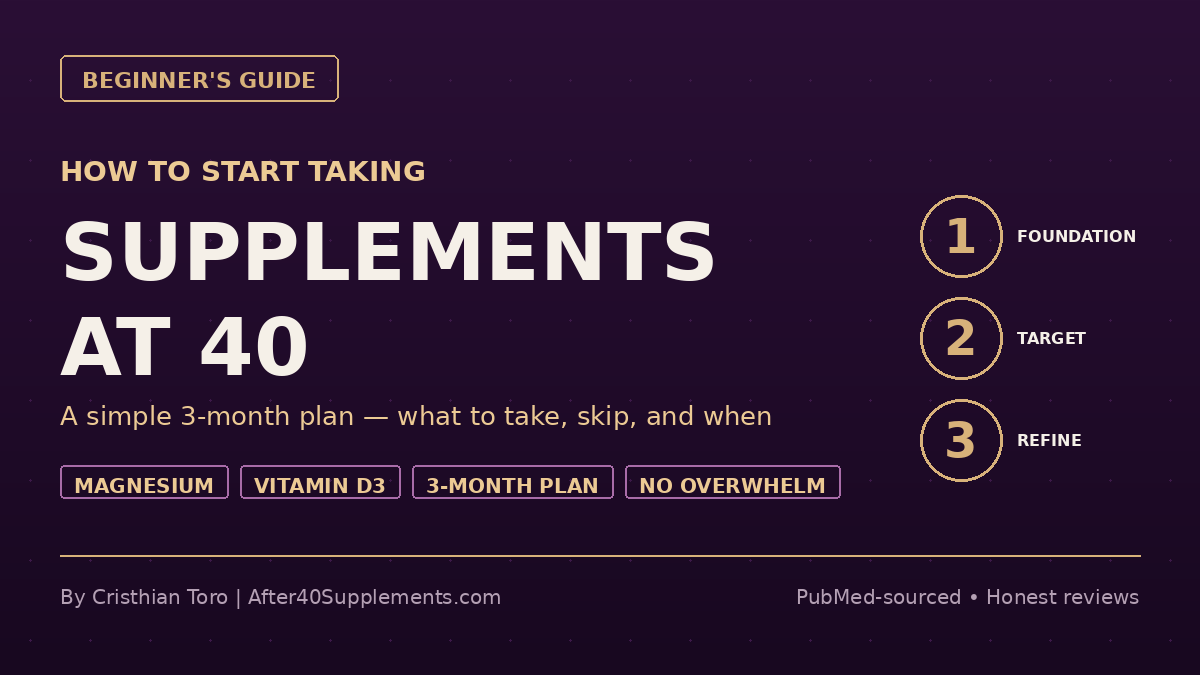
How to start taking supplements at 40 in one line: begin with magnesium glycinate and vitamin D3 in month 1, add one targeted supplement in month 2 based on your biggest concern, then reassess with bloodwork by month 3.
Foundation stack: magnesium glycinate (200-400mg with dinner) + vitamin D3 (2,000 IU with a fatty meal). Total cost ~$15-20/month.
Get bloodwork done first. Vitamin D, B12, iron/ferritin, RBC magnesium, and a thyroid panel turn guessing into targeted supplementation.
Skip: mega-dose multivitamins, testosterone boosters, fat burners, collagen gummies, anything with a “proprietary blend.”
Golden rule: add only one new supplement every 2-4 weeks so you can actually tell what’s working. More than 4-5 daily supplements is where things stop being useful and start being a chore.
So you’ve decided to start taking supplements. Maybe your doctor mentioned a deficiency. Maybe you’re feeling more tired than usual. Maybe you just realized that 40 hit different and you want to do something about it.
The problem? You walk into a supplement store or open Amazon and you’re hit with thousands of options, conflicting advice, and marketing that promises everything short of immortality. It’s overwhelming, and most people either buy too much or give up entirely.
This guide on how to start taking supplements at 40 is designed to cut through all of that. No complicated stacks, no spending $200/month, no confusion. Just a clear, simple plan to get started the right way.
Step 1: Get Your Bloodwork Done First
Before you spend a single dollar on supplements, do this: ask your doctor for a comprehensive blood panel. This is the single most important step, and skipping it means you’re guessing.
The tests that matter most after 40:
Vitamin D (25-hydroxyvitamin D). Arguably the most common deficiency in adults. Optimal range is 40-60 ng/mL. Most people are well below this, especially if you work indoors.
Vitamin B12. Absorption decreases with age. Low B12 causes fatigue, brain fog, and mood issues that many people attribute to “just getting older.”
Iron and Ferritin. Especially important for women who are still menstruating. Low ferritin causes fatigue even when iron levels appear normal on basic tests.
Magnesium (RBC Magnesium). Standard blood tests don’t measure magnesium well. Ask for RBC (red blood cell) magnesium, which is more accurate. Deficiency is extremely common.
Thyroid panel (TSH, Free T3, Free T4). Thyroid function affects energy, weight, and mood. It’s worth checking before assuming you need supplements for fatigue.
Lipid panel and fasting glucose. These inform heart and metabolic health decisions, including whether CoQ10 and omega-3s should be priorities.
Why this matters: Knowing your actual levels turns supplement choices from guesswork into targeted decisions. You might discover you desperately need vitamin D but have plenty of B12. Or you might find that your fatigue is thyroid-related, not a supplement issue at all.
Step 2: Start With the Foundation (Month 1)
Don’t try to build a 10-supplement stack on day one. Start with the two supplements that benefit the broadest range of people over 40:
Magnesium Glycinate
Why it’s foundational: According to a 2012 study by Rosanoff et al. in Nutrition Reviews, an estimated 50% of Americans consume less than the recommended amount of magnesium, affecting sleep, stress, muscle function, blood pressure, and over 300 biochemical reactions. It’s the supplement with the widest impact for the most people.
What to buy: Doctor’s Best High Absorption Magnesium — ~$15 for a two-month supply. Read our full Doctor’s Best Magnesium Glycinate review for the deep dive, or compare forms in our magnesium glycinate vs citrate guide.
How to take: 200mg with dinner or 1 hour before bed. Start here for a week, then increase to 400mg if tolerated well.
What you’ll notice: Better sleep within 1-2 weeks. Fewer muscle cramps. A general sense of being more relaxed in the evening.
Vitamin D3
Why it’s foundational: Vitamin D affects bone health, immune function, mood, and hormone production. A 2011 study by Forrest & Stuhldreher in Nutrition Research found that 42% of American adults are vitamin D deficient, with higher rates in those who work indoors, live at northern latitudes, or have darker skin pigmentation.
What to buy: NatureWise Vitamin D3 2,000 IU — ~$15 for a year’s supply.
How to take: 1 softgel with a meal containing fat (vitamin D is fat-soluble). Take in the morning or at lunch.
What you’ll notice: Effects are subtle and cumulative. After 4-8 weeks, many people report improved mood, better immune function, and more energy. The real value is long-term bone and health protection.
Month 1 cost: ~$15-20 total. That’s it. Two supplements, two clear benefits, minimal cost.
Step 3: Add Based on Your Needs (Month 2)
After a month of the foundation, add 1-2 supplements based on your specific concerns:
If Your Main Concern Is Heart Health → Omega-3 Fish Oil
Heart disease risk climbs after 40. Omega-3s (EPA and DHA) reduce inflammation, support healthy cholesterol, and protect cardiovascular function.
What to buy: Nordic Naturals ProOmega — ~$25-30/month.
How to take: 2 softgels with a meal containing fat. Take with lunch or dinner.
If Your Main Concern Is Muscle Loss → Creatine Monohydrate
After 40, muscle loss accelerates. The International Society of Sports Nutrition (Kreider et al., 2017) considers creatine monohydrate the most effective and safest supplement available for increasing muscle mass and strength, with emerging evidence for cognitive benefits in older adults.
What to buy: Nutricost Creatine Monohydrate — ~$20 for 100 servings.
How to take: 5g daily, mixed into water, coffee, or a shake. Timing doesn’t matter — consistency does. See our full creatine after 40 guide for dosing details and why creatine matters more as you age.
If Your Main Concern Is Joint Pain → Collagen or UC-II
Joint stiffness and pain are among the most common complaints after 40. Collagen supports cartilage and connective tissue repair.
What to buy: Vital Proteins Collagen Peptides (~$30-35/month) for general joint and skin support, or Move Free Ultra UC-II (~$15-20/month) specifically for joint comfort.
How to take: Collagen: 10-20g mixed into coffee or a drink, any time of day. UC-II: 1 small capsule daily. Read our full Vital Proteins review, or compare all top collagen options in our best collagen supplements 2026 guide.
If Your Main Concern Is Brain Fog → Vitamin B12
B12 deficiency mimics cognitive decline and is increasingly common after 40 due to reduced stomach acid.
What to buy: Jarrow Formulas Methyl B-12 — ~$8-10 for 100 lozenges.
How to take: 1 lozenge dissolved under the tongue daily. Sublingual absorption bypasses potential digestive issues.
If Your Main Concern Is Stress and Sleep → Ashwagandha
Chronic stress and poor sleep feed each other in a destructive cycle. Ashwagandha breaks this cycle by lowering cortisol and promoting relaxation.
What to buy: Nutricost KSM-66 Ashwagandha — ~$15 for a two-month supply.
How to take: 600mg with dinner for sleep benefits, or with breakfast for daytime stress management. See our full best ashwagandha supplements guide for the top 10 picks compared side-by-side.
Month 2 cost: Add ~$15-30/month depending on which supplement you choose. Total monthly spend: $30-50.
Step 4: Refine and Optimize (Month 3+)
By month 3, you have a foundation in place and you’ve targeted your main concern. Now it’s time to refine:
Recheck your bloodwork. After 3 months of vitamin D supplementation, retest your levels. Adjust your dose up or down based on results. Same for B12 and iron if those were concerns. If your D3 level still sits below 30 ng/mL despite 3 months at 2,000 IU, that is a signal to step up to a correction dose. Nutricost Vitamin D3 5,000 IU is a good fit at this stage: same daily cost as your original 2,000 IU option, third-party tested, 240 softgels per bottle (8-month supply). Use it for 8 to 12 weeks, retest, then step back down to a maintenance dose. Never jump to 5,000 IU without confirmed deficiency, and see our Best Vitamin D Supplements guide for the full breakdown of options at every dose.
Assess what’s working. Are you sleeping better with magnesium? Is the joint pain improving with collagen? Keep what works, drop what doesn’t.
Consider additions if needed. Based on how you feel and what your blood work shows, you might add CoQ10 for heart health, vitamin K2 to pair with your D3 and calcium, or a probiotic for digestive health.
Don’t exceed 4-5 daily supplements. More than this becomes hard to maintain consistently, and the marginal benefit of supplement #6, #7, #8 drops significantly. Focus on the ones that make a real difference for you.
The Supplements Most People Over 40 Don’t Need
Just as important as knowing what to take is knowing what to skip:
Mega-dose multivitamins. Taking 500% of your daily value of 30 vitamins sounds thorough, but your body excretes most of it. Targeted individual supplements at proper doses are more effective and often cheaper.
Testosterone boosters. Most OTC testosterone boosters are underdosed, poorly researched, or both. The supplements that actually support healthy testosterone (zinc, vitamin D, magnesium, ashwagandha) are already in your stack.
Fat burners. These are mostly caffeine in fancy packaging. Save your money and drink coffee.
Collagen gummies. Most contain 1-3g of collagen per serving — far below the 10-20g that research shows is effective. They’re expensive candy with a health label.
Anything with a “proprietary blend.” If a label won’t tell you how much of each ingredient is included, they’re hiding something — usually the fact that key ingredients are underdosed.
Common Beginner Mistakes to Avoid
Buying everything at once. You won’t know what’s helping and what’s not. Add one new supplement every 2-4 weeks so you can assess each one individually.
Expecting immediate results. Most supplements take 2-8 weeks of consistent daily use before you notice meaningful changes. If you quit after a week because you “don’t feel anything,” you never gave it a chance.
Ignoring timing and food pairing. Fat-soluble supplements (D3, CoQ10, omega-3) need to be taken with food containing fat. Magnesium is best taken in the evening. Iron should be taken on an empty stomach with vitamin C. These details matter for absorption.
Not drinking enough water. Creatine, magnesium, and fiber supplements all require adequate hydration to work properly and avoid side effects. Aim for at least 8 glasses of water daily.
Taking supplements instead of fixing your diet. Supplements fill gaps — they don’t replace meals. No amount of pills can compensate for a diet of processed food, insufficient protein, and zero vegetables.
Your Simple 3-Month Plan
| Month | Supplements | Monthly Cost | Focus |
|---|---|---|---|
| Month 1 | Magnesium Glycinate + Vitamin D3 | $15-20 | Foundation — sleep, bones, general health |
| Month 2 | Add 1-2 based on your main concern | $30-50 | Targeting — address your biggest issue |
| Month 3 | Reassess, retest blood work, refine | $30-50 | Optimizing — keep what works, drop what doesn’t |
Common Questions About Starting Supplements at 40
Do I really need to get bloodwork before starting supplements?
For magnesium and vitamin D3 at standard doses, no — these are safe and beneficial for the vast majority of adults over 40. But bloodwork transforms everything else from guessing to targeted decisions. Without it, you might buy iron you don’t need or skip B12 when you’re actually deficient. If cost is an issue, at least test vitamin D, B12, and iron/ferritin — those are the most commonly deficient and the most impactful.
How much should I expect to spend per month on supplements?
A well-designed routine after 40 costs $30-60/month total. Month 1 with just magnesium and vitamin D3 runs about $15-20. Adding one targeted supplement in month 2 typically brings you to $30-50. If you’re spending more than $80/month, you’re probably over-supplementing or paying for premium brands that don’t justify the price.
Can I take all my supplements at the same time?
Some yes, some no. Fat-soluble supplements (D3, CoQ10, omega-3) should go with a meal containing fat. Magnesium works best in the evening. Iron should be taken on an empty stomach, and not at the same time as calcium, magnesium, or coffee (which block absorption). B12 sublingual can be taken anytime. If it’s getting complicated, split into morning (D3, omega-3, B12) and evening (magnesium, ashwagandha) — that covers most cases.
How long before I feel any difference?
It varies by supplement. Magnesium often improves sleep within 1-2 weeks. Ashwagandha shows stress and sleep effects within 2-4 weeks. Vitamin D3, B12, and CoQ10 work at the cellular level and take 4-8 weeks or more for noticeable effects. If you stop after a week because “nothing happened,” you never gave the supplement a real chance. Consistency over 8-12 weeks is where most people finally judge whether something works.
Should I take supplements every day or cycle them?
Most foundational supplements — magnesium, vitamin D3, B12, omega-3, CoQ10 — are designed for daily consistent use, not cycling. Their benefit comes from maintaining steady levels in your body. Ashwagandha is one where some people cycle 8 weeks on and 2 weeks off, though daily use is also fine. Creatine doesn’t need cycling either. Skip advice that tells you to cycle everything — it’s usually marketing, not science.
Can supplements interact with my medications?
Yes, and this is why you should tell your doctor about every supplement you take. Common ones to watch: magnesium with certain antibiotics and blood pressure meds (timing matters), vitamin K2 with warfarin (avoid unless doctor approves), fish oil with blood thinners, and calcium/iron with thyroid medication. Most interactions are about timing rather than incompatibility — taking them 2-4 hours apart is usually enough. Never assume something is safe just because it’s “natural.”
The Bottom Line
Starting supplements after 40 doesn’t need to be complicated or expensive. Begin with magnesium and vitamin D — two supplements that benefit almost everyone. Add targeted support based on your specific concerns and blood work results. And give each supplement time to work before judging it.
The best supplement routine is one you actually follow. Keep it simple, keep it consistent, and let the results guide your decisions. Your body at 40+ responds well to targeted support — you just need to give it the right tools.
Related Reading
Creatine After 40 — muscle preservation basics
Best Supplements for Men Over 40 — full stack breakdown for men
Best Supplements for Women Over 40 — full stack breakdown for women
Best Supplements for Energy After 40 — targeted energy stack
Best Magnesium Supplement for Sleep — deep dive on the foundation supplement
CoQ10 Supplement Review — when and why to add CoQ10
Best Probiotics for Adults Over 40 — gut health support
Sources
- Rosanoff, A., Weaver, C.M., & Rude, R.K. (2012). Suboptimal magnesium status in the United States: are the health consequences underestimated? Nutrition Reviews, 70(3), 153-164. https://pubmed.ncbi.nlm.nih.gov/22364157/
- Forrest, K.Y., & Stuhldreher, W.L. (2011). Prevalence and correlates of vitamin D deficiency in US adults. Nutrition Research, 31(1), 48-54. https://pubmed.ncbi.nlm.nih.gov/21310306/
- Kreider, R.B., Kalman, D.S., Antonio, J., et al. (2017). International Society of Sports Nutrition position stand: safety and efficacy of creatine supplementation in exercise, sport, and medicine. Journal of the International Society of Sports Nutrition, 14, 18. https://pubmed.ncbi.nlm.nih.gov/28615996/
Affiliate Disclosure: This article contains affiliate links. If you purchase through these links, we may earn a small commission at no additional cost to you. We only recommend products we’ve researched and believe in. See our full Affiliate Disclosure for details.
This content is for informational purposes only and is not medical advice. Always consult with your healthcare provider before starting any new supplement regimen.

Cristhian Toro is the founder of After 40 Supplements. He started researching supplements years ago to optimize his training and recovery at the gym, and now translates the science behind popular supplements into clear, honest guides for adults over 40. He’s not a doctor — he’s someone who reads the research, compares the products, and shares what actually works (and what doesn’t), with sources you can verify.